I still remember the first time I really started paying attention to my child’s growth chart.
It was during a routine school health check. The nurse handed me a printed report with numbers I didn’t fully understand at first—BMI, percentile, growth range, all of it.
I smiled and nodded like I understood everything. But honestly, I left that room with one thought in my head:
“Is my child growing normally… or am I missing something important?”
The confusion most parents quietly deal with
If you’re a parent, this might sound familiar.
You look at your child and think:
- They look healthy
- They eat well (most of the time)
- They seem active and energetic
But then you see terms like BMI percentile and growth charts, and suddenly things feel less simple.
That was exactly my situation.
The problem wasn’t my child’s health—it was my understanding of how to measure it properly.
What a child BMI calculator actually does
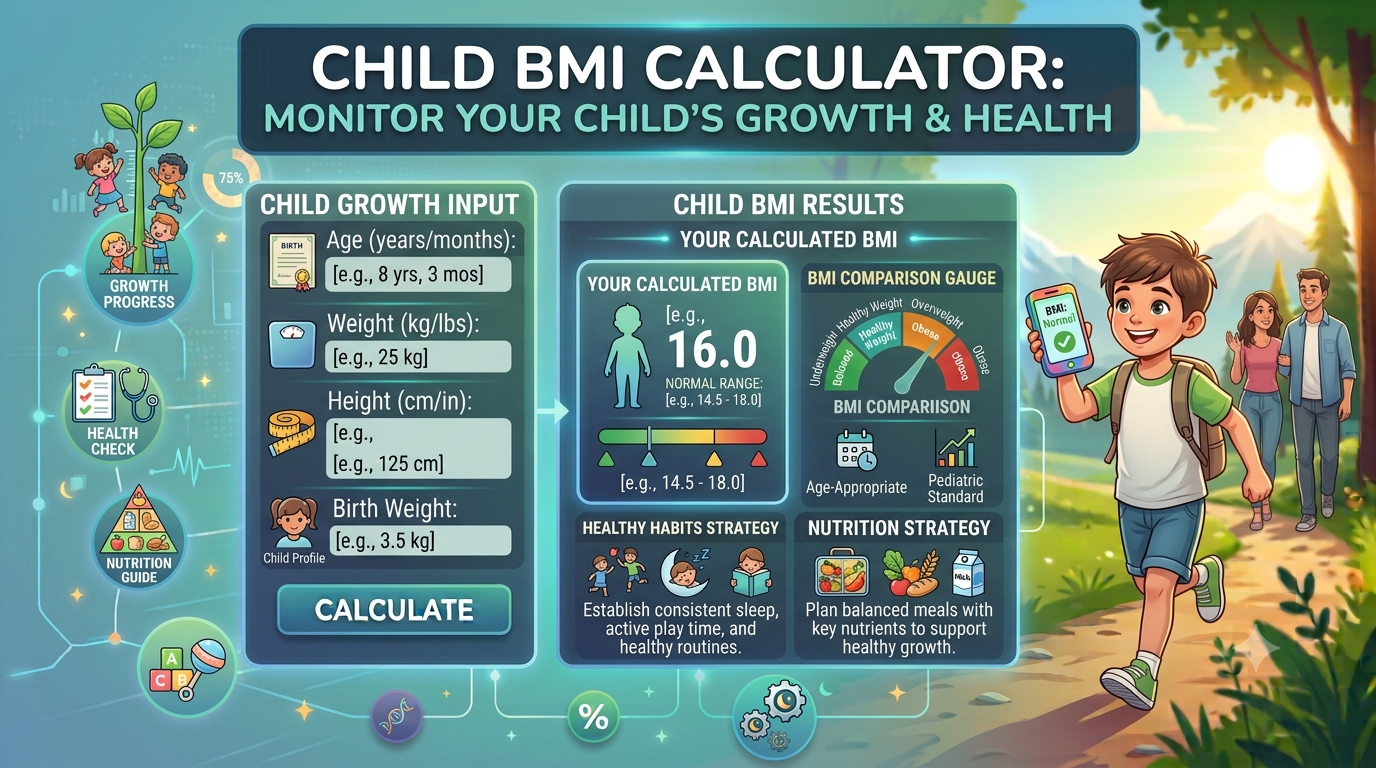
A child BMI calculator is a tool that estimates Body Mass Index for children based on:
- Age
- Gender
- Height
- Weight
But here’s the important part—it doesn’t interpret results the same way as adult BMI.
For children, BMI is compared against growth percentiles, not fixed categories.
That means a child’s BMI is evaluated relative to other children of the same age and gender.
So instead of just saying “normal” or “overweight,” it gives a more detailed growth picture.
My first experience using a child BMI calculator
The first time I used one online, I realized I had been guessing a lot about my child’s growth.
I entered:
- Age
- Weight
- Height
The result showed a percentile range, not just a number.
At first, I didn’t know what to make of it.
But after reading more, I understood that percentiles help track whether a child is growing consistently over time.
And that’s when it made sense:
👉 It’s not about one number—it’s about growth trends.
Why child BMI is different from adult BMI
This was one of the biggest surprises for me.
Adults have fixed BMI categories:
- Underweight
- Normal
- Overweight
But children are different because they are constantly growing.
So child BMI considers:
- Growth spurts
- Age differences
- Gender differences
- Development stages
That’s why pediatric BMI is always interpreted using percentiles.
How a child BMI calculator helps parents
Once I started using it properly, I realized it helps in several ways:
- Tracks healthy growth over time
- Identifies sudden changes early
- Helps discuss concerns with doctors
- Gives context to weight and height changes
- Reduces unnecessary worry or assumptions
It doesn’t replace medical advice, but it helps you understand what doctors are talking about.
The mistake I was making before
For a long time, I focused only on weight.
So my thinking was:
- If weight increases, child is healthy
- If weight decreases, something is wrong
But that approach was too simplistic.
Children grow in different patterns, and weight alone doesn’t show the full picture.
Sometimes height changes faster than weight. Sometimes it’s the opposite.
Without BMI context, it’s easy to misinterpret normal growth.
Tools I started using for tracking growth
I didn’t want anything complicated, so I kept it simple:
- Online child BMI calculators
- WHO growth chart references
- Google Sheets for tracking height and weight over time
- A basic measuring tape at home
- School health check reports for comparison
The most useful habit wasn’t the tool—it was consistency in tracking.
How to use a child BMI calculator properly
Here’s the simple process I follow now:
Step 1: Measure accurately
- Use a proper scale for weight
- Measure height against a wall
- Avoid estimates
Step 2: Enter correct age and gender
These are essential for percentile calculation.
Step 3: Use the calculator occasionally, not daily
Growth tracking is about trends, not daily changes.
Step 4: Compare over time
One result is not meaningful. Patterns are.
Step 5: Discuss results with a pediatrician if needed
Especially if there are consistent concerns.
Real-life example that made it clearer
Let’s take two children:
Child A
- BMI slightly higher
- Height growing steadily
- Active lifestyle
Child B
- BMI lower
- Slow height growth over time
- Low energy levels
On paper, BMI alone doesn’t explain everything.
But when you look at growth patterns, the picture becomes much clearer.
That’s why pediatric BMI is just one part of the bigger story.
Common mistakes parents make
I made a few of these myself early on:
Mistake 1: Checking too frequently
Daily changes mean nothing in growth tracking.
Mistake 2: Comparing children
Every child has a different growth timeline.
Mistake 3: Panicking over single readings
One result doesn’t define health.
Mistake 4: Ignoring height growth
Height matters as much as weight.
Mistake 5: Not tracking consistently
Without history, data has little meaning.
What changed after I started using BMI tracking properly
Once I started using child BMI calculators the right way, I noticed:
- Less anxiety about small changes
- Better understanding of growth patterns
- More meaningful doctor conversations
- Clearer tracking of development over time
- More confidence in interpreting health reports
It didn’t turn me into an expert—but it made me more informed.
A simple way to understand child BMI
Here’s how I now think about it:
Child BMI is not a label—it’s a tracking tool.
It helps answer:
- Is my child growing consistently?
- Is weight increasing appropriately with height?
- Is development on track for age?
It’s not about “good” or “bad”—it’s about patterns.
When a child BMI calculator is useful
It’s especially helpful if you:
- Want to monitor growth at home
- Have concerns about weight changes
- Want to understand school health reports
- Are tracking nutrition and activity habits
- Need context before pediatric visits
Even healthy children benefit from occasional tracking.
Final thoughts
Using a child BMI calculator didn’t make me obsess over numbers—it actually reduced confusion.
Before, I looked at weight and guessed. Now, I understand growth in context.
The biggest lesson I learned is simple:
Children don’t grow in straight lines. They grow in patterns.
And tools like BMI calculators don’t define your child—they just help you understand those patterns a little better.
At the end of the day, it’s not about numbers on a screen. It’s about making sure your child is growing steadily, happily, and in a healthy direction over time.
Suggested outbound reference: For evidence-based guidance on child growth standards, see the official https://www.who.int/tools/child-growth-standards.
Written & Reviewed by Dr. Zil e Norain Tanveer
MBBS | Health & Wellness Expert |
Dr. Zil e Norain Tanveer is a qualified medical professional with a focus on preventive healthcare, nutrition, and wellness education. She reviews all health content on HealthCalc to ensure accuracy and reliability for every reader.