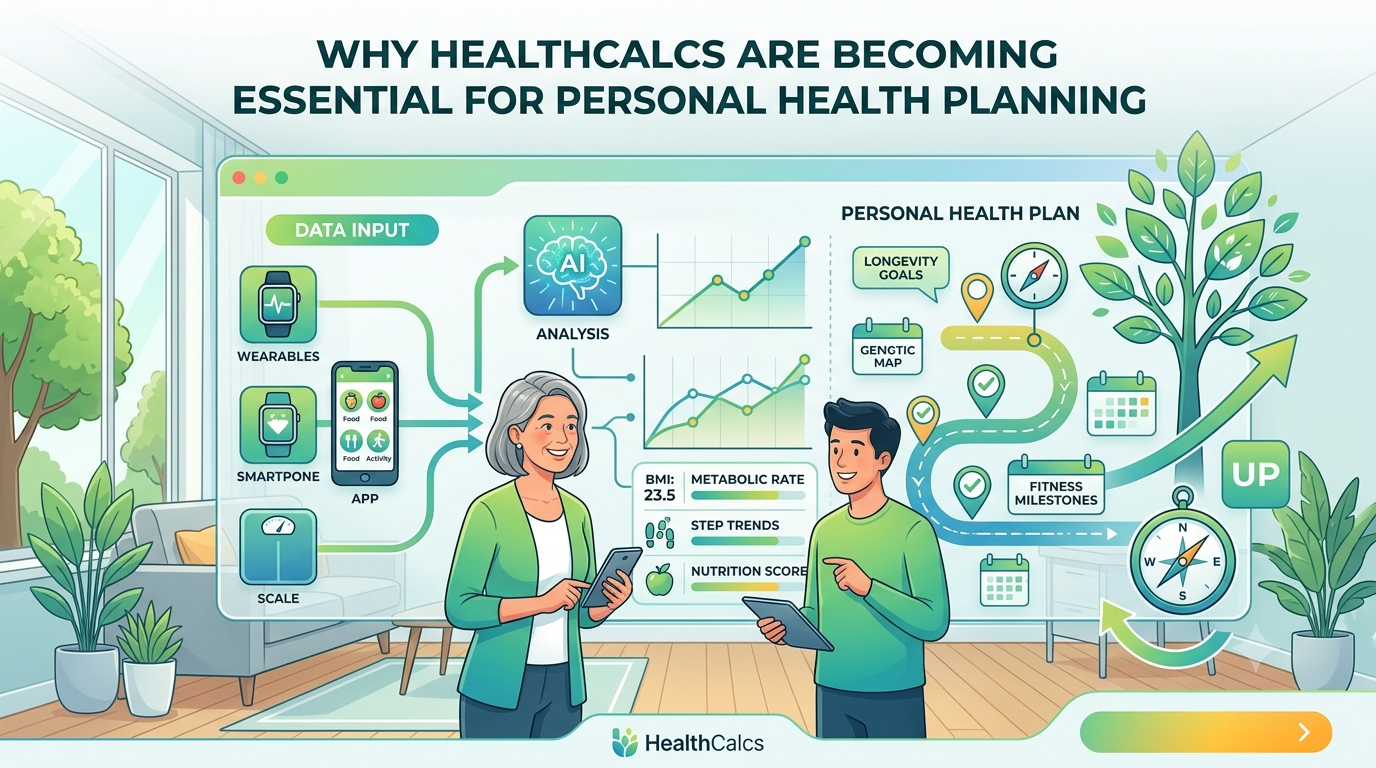
A while back, I remember sitting on my bed after a workout, sweating and tired, thinking I was finally “doing everything right.”
I had started eating better, exercising regularly, and even cutting down on late-night snacks. On the surface, it looked like progress.
But when I checked my results over a few months… nothing really made sense.
Some weeks I felt leaner. Other weeks I felt like I had gone backward. My weight kept bouncing around for no clear reason. And the most frustrating part was not knowing whether I was actually improving or just spinning my wheels.
That’s when I started paying attention to HealthCalcs tools.
Not as some fancy tech thing—but as a simple way to understand what my body was actually doing.
And honestly, that changed how I think about health planning entirely.
The Real Problem: Most People Are Planning Their Health Blind
One thing I didn’t realize early on is this:
Most people don’t actually plan their health—they guess it.
I was guilty of it too.
I guessed my calorie intake.
I guessed my activity level.
I guessed whether I was in shape or not.
And when results didn’t match expectations, I blamed motivation, workouts, or even genetics.
But the truth was simpler—I just didn’t have enough data about myself.
That’s where HealthCalcs started making sense.
Why HealthCalcs Are Becoming More Important Now
What surprised me most is how normal these tools have become.
A few years ago, I barely used any health calculators. Now they’re part of almost every fitness app or smartwatch.
Tools like:
- MyFitnessPal for calorie tracking
- Fitbit for sleep and activity tracking
- Apple Health for overall health data
- Online calculators for BMI, BMR, and body fat
They’re not just “extras” anymore. They’re becoming part of basic health awareness.
And there’s a reason for that.
Health is getting more personalized.
What works for one person doesn’t always work for another. So guessing less and measuring more is becoming essential.
My First Wake-Up Call: Calories Are Not Guesswork
The first time I used a calorie calculator, I honestly didn’t trust it.
It told me I was eating more than I thought. I remember thinking, “No way, I don’t even eat that much.”
But when I started tracking using MyFitnessPal, reality hit differently.
I wasn’t overeating in obvious ways.
It was small things:
- Extra cooking oil
- Snacks here and there
- Weekend meals
- Drinks I wasn’t counting
Nothing dramatic individually—but together, it mattered a lot.
That’s when I realized:
If you don’t measure it, you’re just guessing.
The Shift From Random Effort to Structured Planning
Before using HealthCalcs tools, my health routine looked like this:
- Work out when motivated
- Eat “healthy” most of the time
- Hope for results
After using these tools, it changed to:
- Know my calorie range
- Understand my BMR and TDEE
- Track progress weekly
- Adjust based on actual data
Same effort—but completely different structure.
That structure is what made progress more consistent.
The Most Useful HealthCalcs Tools I Personally Use
Over time, I figured out which calculators actually matter in real life.
Not all of them are equally useful every day, but these became my core ones.
1. BMI Calculator
I don’t rely on it heavily anymore, but it’s still useful as a quick snapshot.
It helped me initially understand where I stood, even if it wasn’t perfect.
2. BMR Calculator
This one helped me understand why extreme dieting never worked for me.
I was eating below what my body actually needed just to function.
No wonder I felt tired all the time.
3. TDEE Calculator
This became the foundation of my planning.
Once I understood my daily energy burn, everything else became easier:
- Weight loss
- Maintenance
- Muscle gain
It gave me direction instead of confusion.
4. Body Fat Calculator
This one completely changed how I view progress.
The scale used to control my mood.
Now I know better.
Fat loss and weight loss are not the same thing.
5. Water Intake Calculator
I ignored hydration for a long time.
I thought I was fine.
Turns out I wasn’t even close.
Once I adjusted my water intake, my energy levels became more stable throughout the day.
A Real Example That Made It All Click
A friend of mine was frustrated because he wasn’t losing weight despite “eating clean.”
We checked his routine using a calorie calculator and tracked his food for a few days.
The issue wasn’t his meals—it was inconsistency.
Weekdays were fine. Weekends were completely off track.
Once he saw that clearly, he didn’t need motivation anymore.
He just needed awareness.
That’s something I see again and again.
Why HealthCalcs Work Better Than Motivation Alone
Motivation comes and goes.
Some days you feel focused. Other days you don’t care.
But numbers don’t change based on mood.
That’s why HealthCalcs tools are so useful—they give you something stable to rely on.
Instead of asking:
“Am I doing enough?”
You start asking:
“Am I following my plan?”
That shift makes everything more structured.
Simple Steps I Follow for Health Planning Now
I don’t overcomplicate things anymore. My system is simple.
Step 1: Set a baseline
- BMI
- BMR
- TDEE
Step 2: Choose one goal
- Fat loss
- Maintenance
- Muscle gain
Step 3: Track basics
- Calories (light tracking)
- Water intake
- Steps
Step 4: Review weekly
- Weight trend
- Energy levels
- Consistency
Step 5: Adjust monthly
- Recalculate TDEE if needed
- Fine-tune intake
That’s it.
No complicated system. Just consistency.
Common Mistakes People Make With HealthCalcs
I’ve made most of these myself, so I can say this from experience.
1. Using too many tools at once
It creates confusion instead of clarity.
2. Obsessing over daily changes
Your body doesn’t change in 24 hours.
3. Entering wrong data
Guessing activity level ruins accuracy.
4. Ignoring long-term trends
Progress shows over weeks, not days.
5. Expecting perfection
These tools are estimates, not exact science.
Once I stopped doing these things, everything became easier.
How Apps Made HealthCalcs Even More Useful
The calculators alone are helpful, but apps made everything practical.
- MyFitnessPal → food tracking
- Fitbit → sleep + activity
- Apple Health → overall monitoring
- Google Fit → simple daily overview
- Cronometer → detailed nutrition tracking
They turn numbers into habits.
One Helpful Resource I Still Use
Whenever I want quick and simple health calculations in one place, I use:
https://www.calculator.net/health-calculator.html
It’s easy, fast, and covers most basic health metrics without overcomplication.
Final Thoughts From Real Experience
The biggest thing I’ve learned from using HealthCalcs tools is this:
Health doesn’t improve just because you try harder—it improves when you understand what you’re doing.
Before I used these tools, I was working hard but guessing everything.
After using them, I wasn’t perfect—but I was informed.
And that made all the difference.
Not because it made things easier, but because it made things clearer.
And in health planning, clarity is often what keeps you consistent long enough to actually see results.
Written & Reviewed by Dr. Zil e Norain Tanveer
MBBS | Health & Wellness Expert |
Dr. Zil e Norain Tanveer is a qualified medical professional with a focus on preventive healthcare, nutrition, and wellness education. She reviews all health content on HealthCalc to ensure accuracy and reliability for every reader.