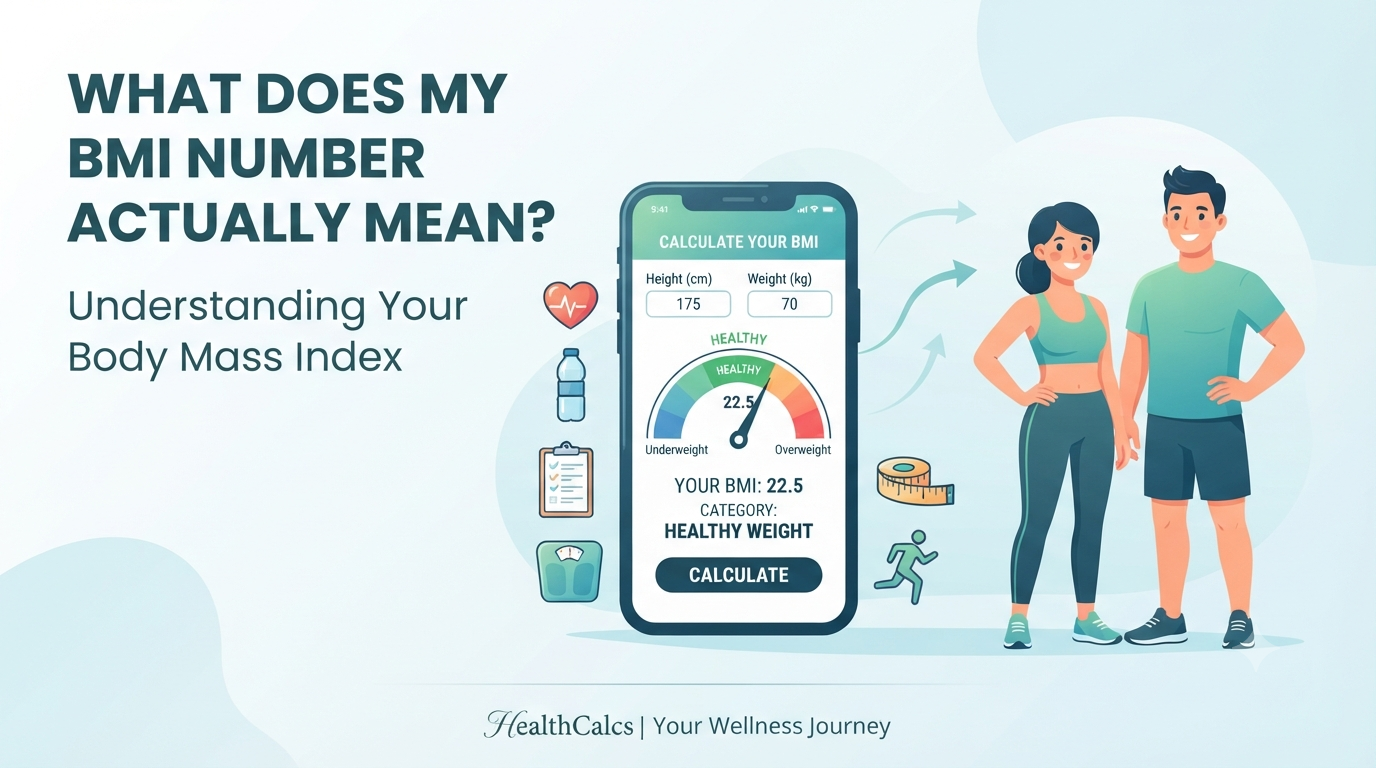
I still remember the moment I typed my height and weight into one of those free BMI calculators online and stared at the result like it had personally offended me.
The number was 27.4. The app labeled it "Overweight" in bold orange text, complete with a little warning icon. I was 29 at the time, running three times a week, and genuinely thought I was in decent shape. That orange label messed with my head for weeks.
But here's the thing — after months of actually digging into what BMI means (and more importantly, what it doesn't mean), I realized I'd been reading that number completely wrong. And based on conversations with friends, coworkers, and half the comment sections on fitness subreddits, most people are in the same boat.
So let me break this down the way I wish someone had explained it to me.
First, What Is BMI Actually Calculating?
BMI stands for Body Mass Index. The formula itself is almost laughably simple: it's your weight in kilograms divided by your height in meters squared. That's it.
If you're working in pounds and inches, most calculators handle the conversion for you. Apps like MyFitnessPal, Apple Health, or even a basic Google search ("BMI calculator") will spit out your number in about ten seconds.
The number you get falls into one of four categories according to standard charts:
- Under 18.5 — Underweight
- 18.5 to 24.9 — Normal weight
- 25 to 29.9 — Overweight
- 30 and above — Obese
Simple, right? That's exactly the problem.
What the Number Actually Tells You
BMI is essentially a rough population-level screening tool. It was developed in the 1800s by a Belgian mathematician named Adolphe Quetelet — and yes, he was a mathematician, not a doctor. It was designed to describe averages across large groups of people, not to diagnose individual health.
When doctors or researchers use BMI at scale — like studying whether a city's population is trending heavier over decades — it works reasonably well as a broad indicator. It's cheap, fast, and requires no special equipment.
For you specifically, sitting there with your number on your phone screen? It's a starting point, not a verdict.
The Part Nobody Told Me: Muscle vs. Fat
This is where my "overweight" result stopped feeling like a crisis.
BMI has no way to distinguish between a pound of muscle and a pound of fat. They weigh the same. But they look different, they take up different amounts of space, and they have very different effects on your health.
Someone who strength trains regularly — even recreationally — will often carry more lean muscle mass than the average person. That extra muscle pushes their weight up, which pushes their BMI up, which can tip them into the "overweight" category on paper while they're genuinely in excellent metabolic health.
This is why plenty of professional athletes technically have "overweight" or even "obese" BMIs. LeBron James has been flagged as overweight by BMI standards. So has most of the NFL. Nobody's handing them a diet pamphlet.
On the flip side, someone can have a completely "normal" BMI while carrying a high percentage of body fat — a pattern sometimes called "skinny fat" in informal discussions, or more clinically, "normal weight obesity." That person might not be flagged by BMI but could still be at elevated risk for metabolic issues.
So What Does It Actually Mean If Your Number Is High?
It's a signal worth paying attention to — not a diagnosis.
If your BMI is in the overweight or obese range, it statistically correlates with higher risk for things like type 2 diabetes, cardiovascular disease, joint stress, and sleep apnea. That correlation is real and worth taking seriously.
But correlation isn't causation, and a number alone doesn't tell you why your BMI is where it is or what your actual health picture looks like.
Think of BMI like the oil warning light in your car. When it comes on, you don't immediately know if you're a quart low or if there's a serious leak. You just know it's worth checking further.
What to Look At Alongside Your BMI
After my "overweight" scare, I started paying attention to a few other numbers that gave me a much fuller picture. Here's what actually helped:
Waist circumference. This one surprised me with how useful it is. Fat stored around your abdomen — visceral fat — carries more health risk than fat stored in other places. A waist measurement above about 40 inches for men or 35 inches for women is generally considered a risk flag, independent of what your BMI says. You just need a soft measuring tape.
Waist-to-height ratio. Some researchers actually prefer this over BMI for predicting cardiometabolic risk. The rough rule of thumb: your waist should be less than half your height. It's not perfect, but it accounts for body frame better than BMI.
Body fat percentage. This is harder to measure accurately at home, but smart scales (brands like Withings or Tanita use bioelectrical impedance) give you an estimate. It's not as accurate as a DEXA scan, but it's useful for tracking trends over time. Healthy body fat ranges differ by age and sex, but generally speaking, 14–24% for men and 21–31% for women is considered a healthy range in most adult guidelines.
How you actually feel and function. I know that sounds soft, but your resting heart rate, how quickly you recover from exertion, your energy levels, and your blood pressure are all telling you things a BMI chart can't.
How to Actually Use Your BMI Number
Here's the practical approach I've landed on after sorting through all of this:
Step 1: Calculate it, but don't catastrophize it. Use any reliable calculator — the NIH has one, as does the CDC. Log the number.
Step 2: Check your waist circumference. Measure at the level of your navel, relaxed, first thing in the morning for consistency.
Step 3: Consider the context. Are you strength training regularly? Are you an athlete? Are you carrying most of your weight in your midsection versus your hips and thighs? These things matter enormously.
Step 4: Bring it to your doctor as a data point, not a diagnosis. If your BMI is elevated and you haven't had bloodwork done recently, that's the actual useful next step — checking things like fasting glucose, cholesterol, blood pressure, and triglycerides. Those numbers will tell you far more than BMI alone.
Step 5: Track changes over time rather than obsessing over a single number. If your BMI drops from 29 to 26 over six months and your waist measurement is going down, you're moving in a good direction. One snapshot doesn't tell you much.
Common Mistakes People Make With BMI
Taking it too literally. A BMI of 25.1 doesn't make you meaningfully different from a BMI of 24.9. The cutoffs are guidelines derived from population statistics, not biological cliff edges.
Ignoring it entirely just because it's imperfect. Yes, it has limitations — but for most average adults who aren't heavily muscled, BMI still loosely tracks with overall body composition. Dismissing it completely isn't the answer either.
Using it as the only metric for a weight loss goal. I've seen people aim to get into the "normal" BMI range and hit it while still feeling terrible, because they lost muscle along with fat. The scale number and the BMI moved, but their body composition got worse.
Comparing yourself to BMI charts without accounting for ethnicity. This is an underappreciated issue. Research has shown that the standard BMI cutoffs — developed from data on mostly European populations — may not apply equally across ethnic groups. Some studies suggest lower thresholds are more appropriate for people of Asian descent, for example. If this applies to you, it's worth discussing with your doctor.
The Bottom Line
BMI is a blunt tool. It was never designed to capture the complexity of individual human health, and it does a mediocre job of it.
But "mediocre" doesn't mean "useless." At a population level, it predicts health risks with enough consistency that it's still used widely in medicine and public health. At an individual level, it's a rough starting point — one data point in a much bigger picture.
When I went back to that BMI calculator result and stopped reading it as a verdict, I was able to use it for what it actually is: a nudge to look more carefully. My bloodwork came back fine. My waist measurement was in a healthy range. My resting heart rate was solid.
The orange "Overweight" label hadn't changed. But my understanding of what it actually meant had changed completely.
If your number has you worried, use that worry productively — not to spiral, but to actually check in with the other numbers that paint a fuller picture of where you stand. Talk to your doctor. Get the bloodwork. Measure your waist.
That's the kind of action a BMI number is good for pointing you toward. It's just not good at giving you the answer by itself.
Written & Reviewed by Dr. Zil e Norain Tanveer
MBBS | Health & Wellness Expert |
Dr. Zil e Norain Tanveer is a qualified medical professional with a focus on preventive healthcare, nutrition, and wellness education. She reviews all health content on HealthCalc to ensure accuracy and reliability for every reader.