I still remember staring at my meal plate one evening and thinking, “I’m eating healthy… but why am I not seeing any changes?”
It was grilled chicken, rice, and vegetables. Nothing fancy, nothing junky. Yet my progress in the gym felt stuck, my energy was inconsistent, and my body didn’t really change the way I expected.
At that time, I was focused only on calories. If I stayed under a certain number, I thought I was doing everything right.
Then a friend who was into fitness casually asked me:
“Do you even know your macros?”
That was my introduction to a macro calculator—and honestly, it changed how I look at food completely.
The mistake I was making without realizing it
Like most beginners, I thought weight loss or fitness was just about eating less.
So my approach looked like this:
- Reduce portion sizes
- Skip snacks
- Avoid “bad foods”
- Eat randomly as long as calories stayed low
But something felt off.
Some days I was tired. Some days I was hungry all the time. And workouts felt inconsistent.
The problem wasn’t just calories—it was what those calories were made of.
What “macros” actually mean in simple terms
Macros is short for macronutrients. There are three main ones:
- Carbohydrates → energy for your body
- Protein → muscle repair and growth
- Fats → hormones, brain function, overall health
Your body needs all three.
Not just calories.
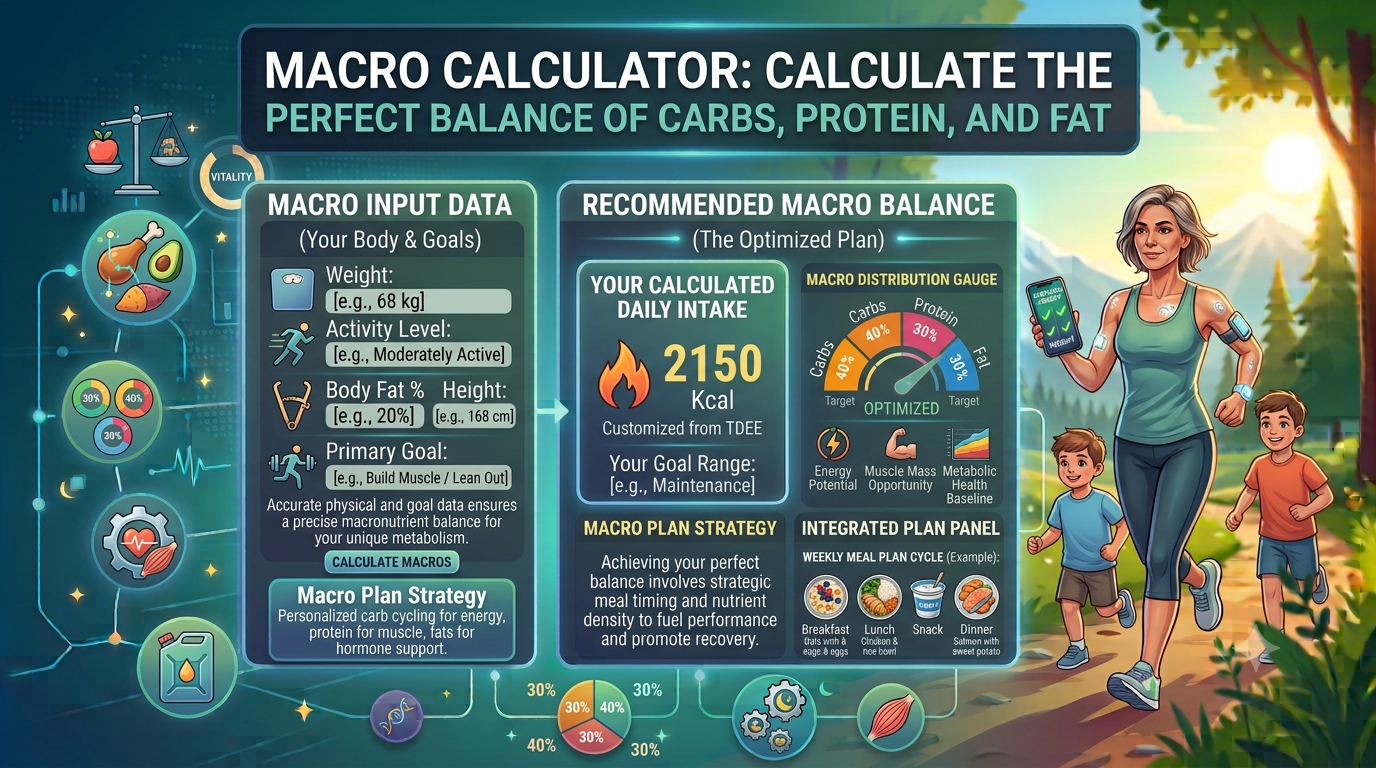
A macro calculator helps you figure out the right balance of these nutrients based on your body, activity level, and goals.
My first time using a macro calculator
The first time I used one, I honestly expected something complicated.
But it was surprisingly simple:
- Enter age
- Enter weight
- Enter height
- Choose activity level
- Select goal (fat loss, maintenance, muscle gain)
Within seconds, it showed me a breakdown of:
- Protein grams
- Carbs grams
- Fat grams
- Daily calorie target
And that’s when things started to make sense.
I wasn’t eating “wrong food.” I was just not balancing it properly.
Why macro balance matters more than just calories
One of the biggest lessons I learned is this:
Two people can eat the same number of calories and get completely different results.
Why?
Because macros affect:
- Energy levels
- Hunger
- Muscle growth
- Fat storage
- Workout performance
For example:
- Low protein → muscle recovery slows down
- Too many carbs without balance → energy crashes
- Too little fat → hormonal imbalance and fatigue
Calories matter, but macros shape how your body uses those calories.
How a macro calculator works
A macro calculator usually starts with your Total Daily Energy Expenditure (TDEE).
Then it divides your calories into percentages like:
- Protein: 25–35%
- Carbs: 35–50%
- Fats: 20–30%
These aren’t fixed rules—they adjust based on your goal.
For example:
Fat loss goal
- Higher protein
- Moderate carbs
- Lower fat
Muscle gain goal
- Higher carbs
- Higher protein
- Moderate fats
Maintenance
- Balanced distribution
How I used a macro calculator properly
At first, I made things more complicated than needed. Later I simplified my approach.
Step 1: Get accurate body stats
No guessing weight or height. Accuracy matters.
Step 2: Choose your real activity level
This was my biggest mistake early on. I overestimated how active I was.
Step 3: Set a realistic goal
Extreme goals = extreme frustration.
Step 4: Follow the macro breakdown
Instead of random eating, I started planning meals around:
- Protein sources
- Carb sources
- Healthy fats
Step 5: Track for a few weeks
I used a food tracking app to see if I was actually hitting my targets.
Tools that helped me track macros
I didn’t rely on guesswork anymore. A few tools made everything easier:
- MyFitnessPal (calorie and macro tracking)
- Cronometer (more detailed nutrition tracking)
- Google Sheets (simple weekly progress tracking)
- Kitchen scale (for accurate portions)
- Fitness watch (for activity tracking)
The kitchen scale was a game changer. I realized my “small servings” weren’t actually small.
Real-life example of macro balance
Let’s compare two people eating the same calories:
Person A
- High carbs
- Low protein
- Low fat
Result:
- Constant hunger
- Low muscle tone
- Energy crashes
Person B
- Balanced protein, carbs, fats
- Consistent meals
- Proper tracking
Result:
- Steady energy
- Better workouts
- Visible body composition improvement
Same calories. Very different outcomes.
Common mistakes people make with macro calculators
I’ve made most of these myself:
Mistake 1: Ignoring protein
Protein is the most important macro for body composition.
Mistake 2: Fear of carbs
Carbs are not the enemy—they are energy.
Mistake 3: Eating “clean” but unbalanced meals
Healthy food still needs proper macro balance.
Mistake 4: Not tracking properly
Eyeballing portions leads to inaccurate results.
Mistake 5: Changing macros too often
Consistency matters more than perfection.
What changed for me after using macros properly
Once I started following a macro-based approach, I noticed:
- More stable energy throughout the day
- Better gym performance
- Less random snacking
- More predictable progress
- Improved recovery after workouts
But the biggest change was mental clarity around food.
I stopped labeling food as “good” or “bad” and started thinking in terms of balance.
A simple way to understand macros
If calories are your budget, macros are how you spend it.
You can spend all your money on one thing—but it won’t give you balance.
Your body works the same way.
- Protein builds and repairs
- Carbs fuel your activity
- Fats support your system
All three matter.
When a macro calculator is most useful
It helps especially if you:
- Are trying to lose fat without losing muscle
- Want to build lean muscle
- Feel confused about what to eat
- Have hit a fitness plateau
- Want structure instead of random dieting
Even beginners can use it without advanced knowledge.
Final thoughts
A macro calculator doesn’t just tell you how much to eat—it teaches you how to eat better.
Before using it, I thought fitness was about restriction. After using it, I realized it’s about balance.
The biggest shift wasn’t physical at first—it was understanding that food isn’t just about calories, but about composition.
Once you understand macros, you stop guessing and start planning. And that’s when real consistency becomes possible.
Suggested outbound reference: For evidence-based nutrition guidance on macronutrients, see the official Harvard T.H. Chan School of Public Health – Carbohydrates, Protein & Fats Overview.
Written & Reviewed by Dr. Zil e Norain Tanveer
MBBS | Health & Wellness Expert |
Dr. Zil e Norain Tanveer is a qualified medical professional with a focus on preventive healthcare, nutrition, and wellness education. She reviews all health content on HealthCalc to ensure accuracy and reliability for every reader.