I still remember a phase in my life when everyone around me was talking about losing weight, getting lean, cutting calories… and I was sitting there thinking, “I just want to gain a few kilos and feel stronger.”
No matter how much I ate, my weight barely changed. I’d finish a full meal, feel satisfied, and still look at the mirror thinking I looked the same as before.
Worst part? People assumed I was “lucky” because I could eat anything. But in reality, gaining weight was just as frustrating for me as losing weight is for others.
That’s when I first came across a healthy weight gain calculator, and honestly, it changed the way I approached food, workouts, and consistency.
The mistake I was making without realizing it
For a long time, my logic was simple:
- Eat more food
- Add extra meals
- Drink milk shakes
- Hope the scale moves
Sounds reasonable, right?
But the problem was I wasn’t tracking anything properly. Some days I ate a lot, other days I barely ate enough. There was no structure.
And that’s the key issue most people miss when trying to gain weight: inconsistency.
A healthy weight gain calculator helped me understand something important—my body needed a specific calorie surplus, not random eating patterns.
What is a healthy weight gain calculator?
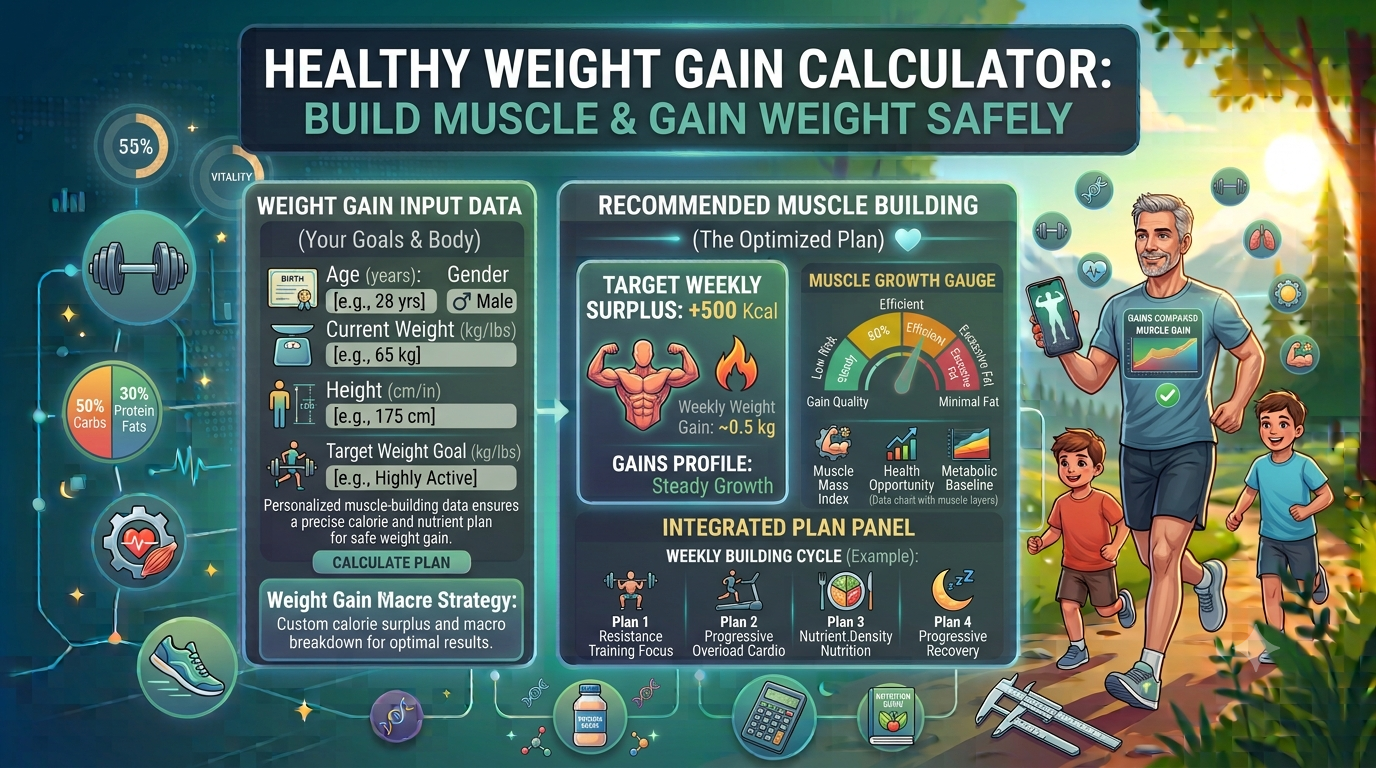
A healthy weight gain calculator is a tool that estimates how many calories you need per day to gain weight safely.
It considers things like:
- Age
- Gender
- Height
- Current weight
- Activity level
- Goal (weight gain or muscle building)
Then it gives you a target calorie intake that puts your body in a controlled surplus.
That surplus is what helps you gain weight gradually—ideally in the form of muscle instead of just fat.
My first experience using a weight gain calculator
The first time I used one, I expected the number to be huge.
I thought I’d need to eat an extreme amount of food every day.
But the result surprised me. It wasn’t crazy at all—just slightly above my maintenance calories.
That’s when it clicked:
You don’t need to eat everything in sight. You just need to consistently eat a bit more than your body burns.
Why most people struggle to gain weight
After talking to others with the same goal, I noticed a pattern.
Most people trying to gain weight do one of these:
- Eat a lot for 2–3 days, then forget about it
- Rely only on junk food
- Skip workouts completely
- Don’t track calories at all
- Expect fast results
The biggest issue is the lack of structure.
A calculator removes guesswork and replaces it with a clear target.
How a healthy weight gain calculator works
It usually calculates your:
1. BMR (Basal Metabolic Rate)
This is how many calories your body burns at rest.
2. TDEE (Total Daily Energy Expenditure)
This includes daily activity and movement.
3. Calorie surplus
This is the extra calories you need to gain weight.
For example:
- Maintenance: 2,200 calories
- Weight gain target: 2,500–2,700 calories
That extra 300–500 calories is what helps you grow steadily.
How I used the calculator properly (after many mistakes)
At first, I made things harder than they needed to be. Later I simplified everything.
Here’s what worked better:
Step 1: Enter accurate body details
No guessing weight or height. Even small differences change the result.
Step 2: Be honest about activity level
This is where I used to mess up.
I thought walking a little meant I was “moderately active.” In reality, I was closer to light activity.
Step 3: Start with a small calorie surplus
I learned that bigger surplus doesn’t mean faster muscle gain.
It often just means more fat gain.
Step 4: Track food for a few weeks
This was a game changer.
I used a simple app to see how much I was actually eating. Turns out, I was under-eating more often than I thought.
Step 5: Adjust slowly
If weight doesn’t increase after 2–3 weeks, add a small amount of calories—not a drastic jump.
Tools that helped me gain weight properly
I didn’t rely only on the calculator. A few tools made the process much easier:
- MyFitnessPal (calorie tracking)
- Google Fit (activity tracking)
- A basic kitchen scale (portion control)
- A gym training log app
- A simple smart scale for weekly weight tracking
The kitchen scale helped the most. I realized my “normal portions” were way smaller than I thought.
Real-life example of weight gain progress
Let’s compare two approaches:
Person A (no structure)
- Eats randomly
- Skips meals often
- No calorie tracking
- Goes to gym inconsistently
Result: very slow or no progress
Person B (uses calculator + tracking)
- Eats consistent calorie surplus
- Tracks meals
- Strength trains regularly
- Monitors weekly weight
Result: steady muscle and weight gain over time
Same goal. Completely different system.
What I learned about gaining weight safely
One of the biggest lessons I learned is that fast weight gain isn’t the goal.
I used to think:
“More food = faster results”
But that usually leads to:
- Fat gain
- Digestive issues
- Feeling sluggish
- Inconsistent progress
A controlled surplus is much more effective.
Common mistakes people make
I’ve made most of these myself:
Mistake 1: Eating too much junk food
It increases weight, but not in a healthy way.
Mistake 2: Skipping strength training
Without resistance training, most weight gain becomes fat.
Mistake 3: Not tracking calories
Guessing leads to inconsistency.
Mistake 4: Expecting overnight results
Healthy weight gain takes time.
Mistake 5: Changing plans too often
Sticking to one plan gives your body time to respond.
What actually changed for me
After using a weight gain calculator consistently, I noticed:
- More stable eating habits
- Gradual increase in body weight
- Better strength in workouts
- Less confusion about food choices
- More confidence in my routine
The biggest change wasn’t physical at first—it was mental clarity.
I finally understood how much I actually needed to eat.
A simple way to think about weight gain
If I had to explain it in the simplest way:
Your body burns a certain number of calories every day just to function. If you consistently eat a little more than that, your body uses the extra energy to build weight.
A healthy weight gain calculator just helps you find that number without guessing.
When a weight gain calculator is most useful
It helps most if you:
- Have a fast metabolism
- Struggle to gain weight
- Want to build muscle
- Are starting strength training
- Don’t know how much to eat
It gives direction when everything feels random.
Final thoughts
A healthy weight gain calculator doesn’t magically make you gain weight—but it removes the confusion that usually slows people down.
For me, it turned a frustrating guessing game into a structured plan. Instead of wondering why I wasn’t gaining weight, I finally understood what I needed to do consistently.
If you’re trying to gain weight or build muscle, the most important thing isn’t eating excessively—it’s eating consistently with a clear target.
Once you know your numbers, everything else becomes a lot easier to manage. And from there, real progress actually starts to feel predictable instead of random.
Suggested outbound reference: For evidence-based nutrition guidance on healthy weight gain and muscle building, you can refer to the official Academy of Nutrition and Dietetics – Healthy Weight Gain Guide.
Written & Reviewed by Dr. Zil e Norain Tanveer
MBBS | Health & Wellness Expert |
Dr. Zil e Norain Tanveer is a qualified medical professional with a focus on preventive healthcare, nutrition, and wellness education. She reviews all health content on HealthCalc to ensure accuracy and reliability for every reader.