There was a time when I thought I was “doing everything right” with my fitness.
I was training regularly, trying to eat better, and even skipping snacks I used to enjoy. On the outside, it looked like progress. But inside, I was constantly guessing.
Was I eating too much?
Too little?
Was my training actually working?
Or was I just… maintaining without realizing it?
That confusion stayed with me for months until I started using HealthCalcs-style tools more seriously. Not as random online gimmicks, but as a way to actually understand what was happening in my body.
And honestly, that changed how I approach health completely.
Why I Stopped Guessing and Started Calculating
One thing I’ve learned the hard way is this:
Effort without clarity feels like running in circles.
I used to rely on how I felt. If I felt “lighter,” I assumed I was improving. If I felt tired, I thought something was wrong.
But feelings change daily. Your body doesn’t improve in daily snapshots—it improves in patterns.
That’s where HealthCalcs tools helped me a lot. They gave me structure when everything else felt random.
Not perfect answers. Just better direction.
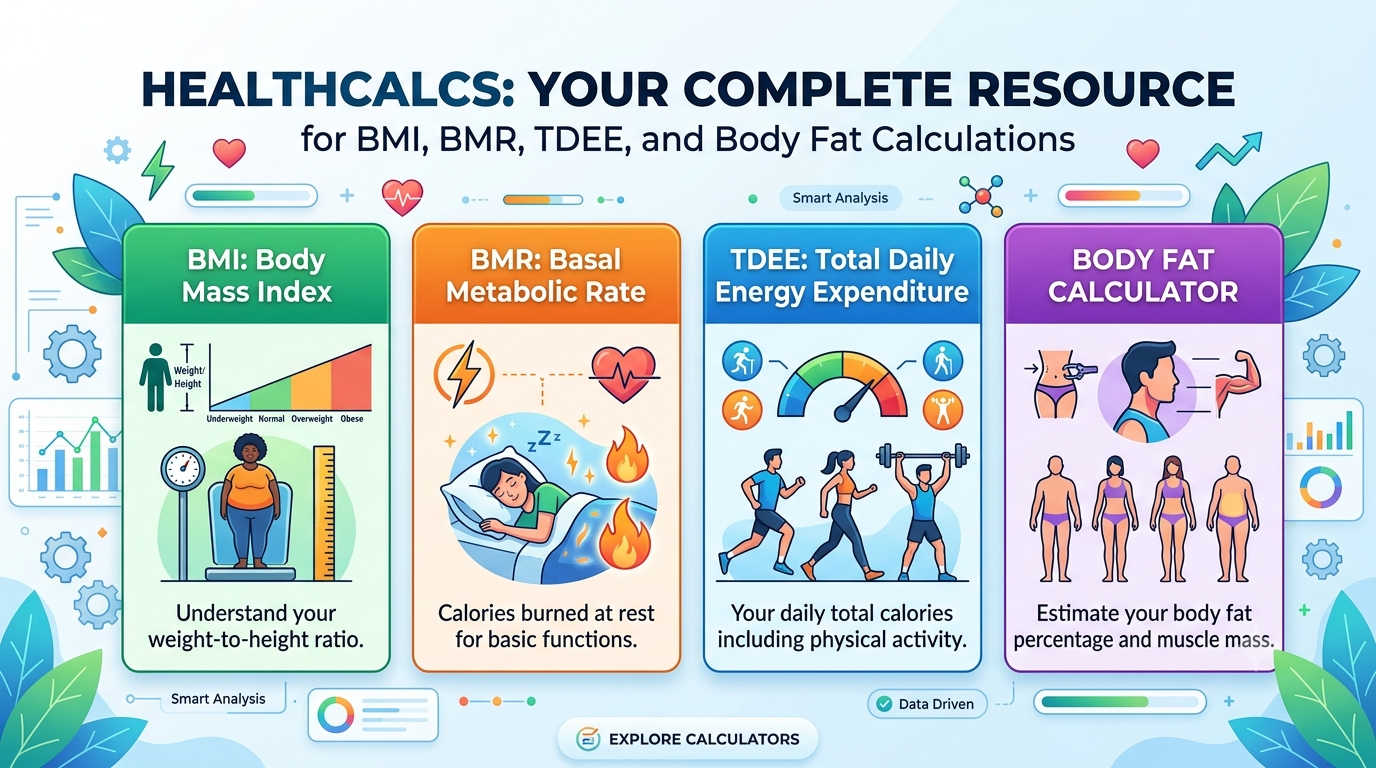
BMI: The First Number That Made Me Think Differently
I still remember the first time I used a BMI calculator.
It felt very simple—just height and weight. I didn’t expect much from it.
But when I saw the result, I paused for a moment.
It wasn’t alarming, but it wasn’t exactly what I assumed either.
That was my first real lesson in health tracking:
What you “feel” and what’s actually happening can be two different things.
What BMI helped me understand:
- General weight category
- Basic health reference point
- Long-term weight trends
What it doesn’t show:
- Muscle mass
- Body fat distribution
- Fitness level
I now treat BMI like a starting point, not a conclusion.
BMR: The Number That Explains Why Diets Fail
BMR (Basal Metabolic Rate) was something I ignored for a long time.
Big mistake.
When I finally calculated it, I understood something important about my past dieting mistakes.
I had been eating too little for my own body.
That explained:
- Constant tiredness
- Low motivation
- Random cravings
- Stalled progress
BMR tells you how many calories your body burns just staying alive—breathing, thinking, functioning.
Once I understood that, I stopped copying extreme diets I saw online.
Instead, I started building something sustainable.
TDEE: The Real Game-Changer for Weight Control
If BMR was important, TDEE (Total Daily Energy Expenditure) was a breakthrough.
This is the number that includes everything:
- Walking
- Exercise
- Daily movement
- General activity
When I first calculated my TDEE, I realized something surprising:
My idea of “how active I am” was not accurate.
I either overestimated on some days or underestimated on others.
Once I started using TDEE properly, things became more stable.
Why TDEE matters:
- Helps set realistic calorie targets
- Makes fat loss structured
- Prevents random dieting approaches
This was the point where fitness stopped feeling like guesswork.
Body Fat Percentage: The Reality Behind the Scale
There was a phase in my journey where the scale didn’t move for weeks.
At first, I thought I had hit a plateau.
But then I checked my body fat percentage using a calculator.
The result changed everything.
I wasn’t stuck—I was changing composition.
Fat was decreasing, and muscle was increasing.
The scale simply couldn’t show that.
Why body fat tracking is important:
- Shows real fat loss progress
- Helps avoid unnecessary frustration
- Gives a clearer picture than weight alone
This was one of the biggest mindset shifts for me.
Lean Body Mass: The Metric Nobody Talks About Enough
Lean body mass was something I only discovered later.
It includes:
- Muscle
- Bones
- Water
- Organs
Basically, everything except fat.
When I started strength training, this metric became important because it helped me understand what I was actually building.
Not just losing weight—but changing body composition.
That’s a very different goal.
How I Actually Use HealthCalcs in Real Life
I don’t use every calculator daily. That would be too much.
Instead, I keep it simple and structured.
Weekly:
- Weight check
- Rough calorie awareness
- Step count (using phone or Fitbit)
Monthly:
- BMI check
- Body fat estimate
- Waist measurement
Every few months:
- Recalculate TDEE
- Adjust calorie targets
- Review progress honestly
This keeps things balanced without turning health into an obsession.
Tools That Help Me Stay Consistent
Health calculators work best when combined with real tracking tools.
These are the ones I’ve personally used:
- MyFitnessPal → food tracking and calorie logging
- Fitbit → sleep, steps, and activity tracking
- Google Fit → basic health overview
- Apple Health → centralized data tracking
- Cronometer → detailed nutrition breakdown
Each one adds a piece to the bigger picture.
A Simple Real-Life Example
A friend of mine once told me:
“I’m eating clean but I’m not losing weight at all.”
We didn’t change his diet immediately.
Instead, we calculated his TDEE and tracked his intake for a few days.
What we found was simple:
- Weekdays were fine
- Weekends were undoing the deficit
Nothing extreme. Just unnoticed habits.
Once he saw the numbers clearly, he didn’t need motivation anymore—just awareness.
That’s the real value of HealthCalcs tools.
They show you patterns you can’t easily see.
Common Mistakes People Make With Health Calculations
I’ve made most of these myself:
1. Treating calculators like exact science
They’re estimates, not medical diagnostics.
2. Changing everything at once
That usually leads to burnout.
3. Ignoring consistency
One good week doesn’t define progress.
4. Using wrong inputs
Guessing activity level ruins accuracy.
5. Obsessing over daily changes
Daily fluctuations mean almost nothing.
Once I stopped doing these things, everything felt more manageable.
One Helpful Resource I Still Use
When I need quick and simple health estimates, I sometimes use:
https://www.calculator.net/health-calculator.html
It’s straightforward and covers most essential health metrics in one place.
Final Thoughts From Personal Experience
The biggest lesson I learned from using HealthCalcs tools is surprisingly simple:
You can’t improve what you don’t understand.
Before I started tracking properly, I was working hard but not really knowing where I stood.
After using BMI, BMR, TDEE, and body fat calculations together, things became clearer—not perfect, but clearer.
And that clarity changed everything:
- My diet became more structured
- My training became more purposeful
- My expectations became more realistic
- My progress became easier to understand
HealthCalcs didn’t do the work for me.
But it helped me see the work more clearly.
And sometimes, that’s exactly what people need to stay consistent long enough to actually see results.
Written & Reviewed by Dr. Zil e Norain Tanveer
MBBS | Health & Wellness Expert |
Dr. Zil e Norain Tanveer is a qualified medical professional with a focus on preventive healthcare, nutrition, and wellness education. She reviews all health content on HealthCalc to ensure accuracy and reliability for every reader.