A few years ago, I was trying my best to get healthier, but honestly, I felt lost.
Every health article seemed to tell me something different. One source said I needed to lose weight. Another said I should focus on body fat percentage. A fitness app told me I needed more calories, while a friend insisted I should eat less.
The more advice I consumed, the more confused I became.
One evening, after spending nearly an hour searching for answers online, I stumbled across a collection of health calculators. At first, I ignored them. I assumed they were only for fitness experts or healthcare professionals.
I was wrong.
Those simple calculators helped me understand my body better than months of random internet research.
Instead of guessing, I could calculate.
Instead of relying on opinions, I could use actual numbers.
That experience completely changed the way I approach health and fitness.
If you've ever wondered whether you're eating the right amount, maintaining a healthy weight, or making progress toward your wellness goals, HealthCalcs can make the process much simpler.
Why I Started Using Health Calculators
One of the biggest mistakes I made early in my fitness journey was relying entirely on assumptions.
I assumed I was eating healthy.
I assumed I was drinking enough water.
I assumed my workouts were effective.
The reality was quite different.
When I started using calculators for things like BMI, calorie needs, body fat percentage, and lean body mass, I quickly discovered gaps in my understanding.
Some results surprised me.
Others confirmed what I already suspected.
Most importantly, they gave me a starting point.
Health calculators won't solve every health problem, but they can help you make more informed decisions.
What Is HealthCalcs?
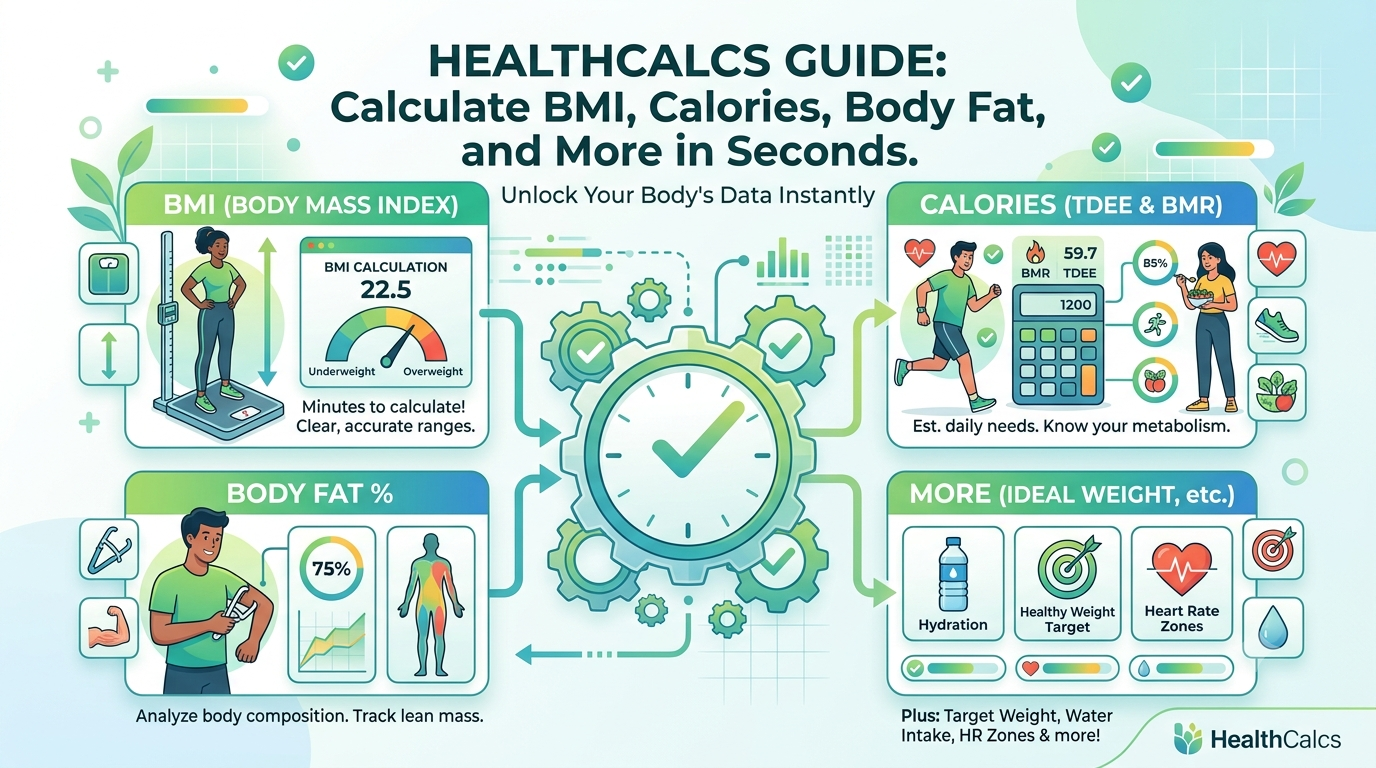
HealthCalcs is essentially a collection of tools designed to help people better understand various aspects of their health.
Instead of manually performing complex calculations, these tools provide quick estimates based on information such as:
- Age
- Height
- Weight
- Activity level
- Waist measurement
- Body fat percentage
The process usually takes less than a minute.
Yet the information can be surprisingly useful.
Let's look at some of the calculators I personally find most valuable.
BMI Calculator: A Quick Health Snapshot
The first calculator I ever used was a BMI calculator.
BMI stands for Body Mass Index.
It compares your height and weight to estimate whether your weight falls within a general healthy range.
When I checked my BMI for the first time, I discovered I was much closer to the overweight category than I had expected.
That wasn't exactly the news I wanted.
But it motivated me to take my health more seriously.
What BMI Can Tell You
A BMI calculator can help you:
- Understand your weight category
- Track changes over time
- Identify potential health risks
What BMI Can't Tell You
One important lesson I learned is that BMI isn't perfect.
It doesn't distinguish between:
- Fat
- Muscle
- Bone mass
That's why it's best used as a starting point rather than a complete assessment.
Calorie Calculator: The Tool That Changed Everything
If I had to choose only one health calculator, it would probably be a calorie calculator.
For years, I guessed how many calories I needed.
I was usually wrong.
Sometimes I ate far too much.
Other times I ate far too little.
Neither approach worked very well.
A calorie calculator estimates your daily energy needs based on factors such as:
- Age
- Gender
- Height
- Weight
- Activity level
When I finally calculated my maintenance calories, everything started making more sense.
I could create a realistic nutrition plan rather than relying on guesswork.
Why It Matters
Knowing your estimated calorie needs can help with:
- Weight loss
- Weight maintenance
- Muscle gain
- Meal planning
Body Fat Calculator: Looking Beyond the Scale
One thing the scale doesn't tell you is how your weight is distributed.
This is where a body fat calculator becomes useful.
I learned this lesson after months of training when my body weight barely changed.
At first, I felt discouraged.
Then I checked my body fat percentage.
While my weight stayed relatively stable, my body composition had improved significantly.
I had lost fat and gained muscle.
Without tracking body fat, I never would have noticed.
Benefits of Tracking Body Fat
- Better progress monitoring
- More accurate fitness assessments
- Improved goal setting
Lean Body Mass Calculator
This calculator became one of my favorites once I started strength training.
Lean body mass includes:
- Muscle
- Bones
- Water
- Organs
- Connective tissues
In simple terms, it's everything except body fat.
Tracking lean body mass helped me focus on building a stronger body rather than obsessing over weight loss.
Sometimes maintaining or increasing lean mass is a bigger achievement than seeing the scale move.
BMR Calculator: Understanding Your Baseline
BMR stands for Basal Metabolic Rate.
It estimates how many calories your body burns while at complete rest.
I remember being shocked when I calculated mine.
It explained why some of my previous low-calorie diets felt impossible to sustain.
My body needed more energy than I realized.
A BMR calculator can help you understand:
- Basic calorie needs
- Energy requirements
- Nutrition planning
Water Intake Calculator
Hydration is one of those habits that seems simple until you actually measure it.
For years, I thought I drank plenty of water.
Then I tracked my intake for a week.
I wasn't even close.
A water intake calculator estimates hydration needs based on:
- Weight
- Activity level
- Climate
- Exercise habits
Once I improved my hydration, I noticed better energy and fewer afternoon headaches.
Sleep Calculator
This was one of the most surprising tools I ever used.
I used to focus only on sleep duration.
I thought eight hours automatically meant quality sleep.
A sleep calculator helped me understand sleep cycles.
By adjusting my bedtime slightly, I started waking up feeling more refreshed.
The difference wasn't dramatic overnight.
But after several weeks, my mornings became noticeably easier.
Biological Age Calculator
This calculator gave me one of the biggest reality checks.
Your chronological age is the number of years you've been alive.
Your biological age attempts to estimate how your body is aging based on lifestyle and health factors.
The first result I received wasn't particularly flattering.
My biological age was older than my actual age.
That motivated me to improve several habits:
- Sleep
- Exercise
- Nutrition
- Stress management
It became a useful benchmark for overall wellness.
How I Use HealthCalcs Today
Over time, I've developed a simple approach.
Instead of checking everything constantly, I focus on a few key metrics.
Monthly Check-In
Once a month, I review:
- Weight
- BMI
- Body fat percentage
- Waist measurement
Nutrition Review
Every few months, I revisit:
- Calorie needs
- BMR estimates
- Activity levels
Lifestyle Review
I also pay attention to:
- Sleep quality
- Water intake
- Exercise consistency
This helps me stay aware without becoming obsessed with numbers.
Common Mistakes People Make
I've made most of these mistakes myself.
Treating Estimates as Exact Numbers
Health calculators provide estimates.
They're useful, but they're not perfect.
Use them as guides.
Obsessing Over Daily Changes
Weight, hydration, and other metrics naturally fluctuate.
Focus on long-term trends.
Using One Calculator Alone
No single calculator tells the entire story.
Combining several tools usually provides better insights.
Ignoring Lifestyle Habits
Calculators don't replace healthy habits.
Good nutrition, exercise, sleep, and stress management still matter most.
Tools That Pair Well With HealthCalcs
Several apps and devices can make tracking easier.
I've personally used:
MyFitnessPal
Helpful for:
- Calorie tracking
- Food logging
- Nutrition monitoring
Fitbit
Useful for:
- Activity tracking
- Sleep monitoring
- Daily movement goals
Apple Watch
Great for:
- Heart rate monitoring
- Exercise tracking
- Activity trends
Garmin
Excellent for:
- Running
- Cycling
- Endurance training
These tools work particularly well alongside health calculators because they provide real-world data.
A Simple Way to Get Started
If you're new to health calculators, don't try everything at once.
Here's what I recommend.
Step 1
Calculate your BMI.
Step 2
Calculate your daily calorie needs.
Step 3
Estimate your body fat percentage.
Step 4
Review your sleep and hydration habits.
Step 5
Track progress monthly rather than daily.
This approach keeps things manageable and prevents information overload.
One Resource Worth Exploring
If you'd like to compare different health calculators and learn more about common health metrics, a helpful resource is:
https://www.calculator.net/health-calculator.html
It offers a variety of tools related to nutrition, fitness, body composition, and general wellness.
What HealthCalcs Taught Me
The biggest lesson wasn't about BMI, calories, or body fat percentages.
It was about awareness.
Before using health calculators, I relied heavily on assumptions.
After using them, I started making decisions based on information.
That shift made a huge difference.
HealthCalcs won't magically transform your health overnight.
What they can do is provide clarity.
They help answer questions that many of us struggle with every day.
Am I eating enough?
Am I making progress?
Am I moving in the right direction?
Having those answers makes it easier to build healthy habits, stay motivated, and make smarter choices over the long term.
And sometimes, that's exactly what we need—not perfection, just a clearer path forward.
Written & Reviewed by Dr. Zil e Norain Tanveer
MBBS | Health & Wellness Expert |
Dr. Zil e Norain Tanveer is a qualified medical professional with a focus on preventive healthcare, nutrition, and wellness education. She reviews all health content on HealthCalc to ensure accuracy and reliability for every reader.