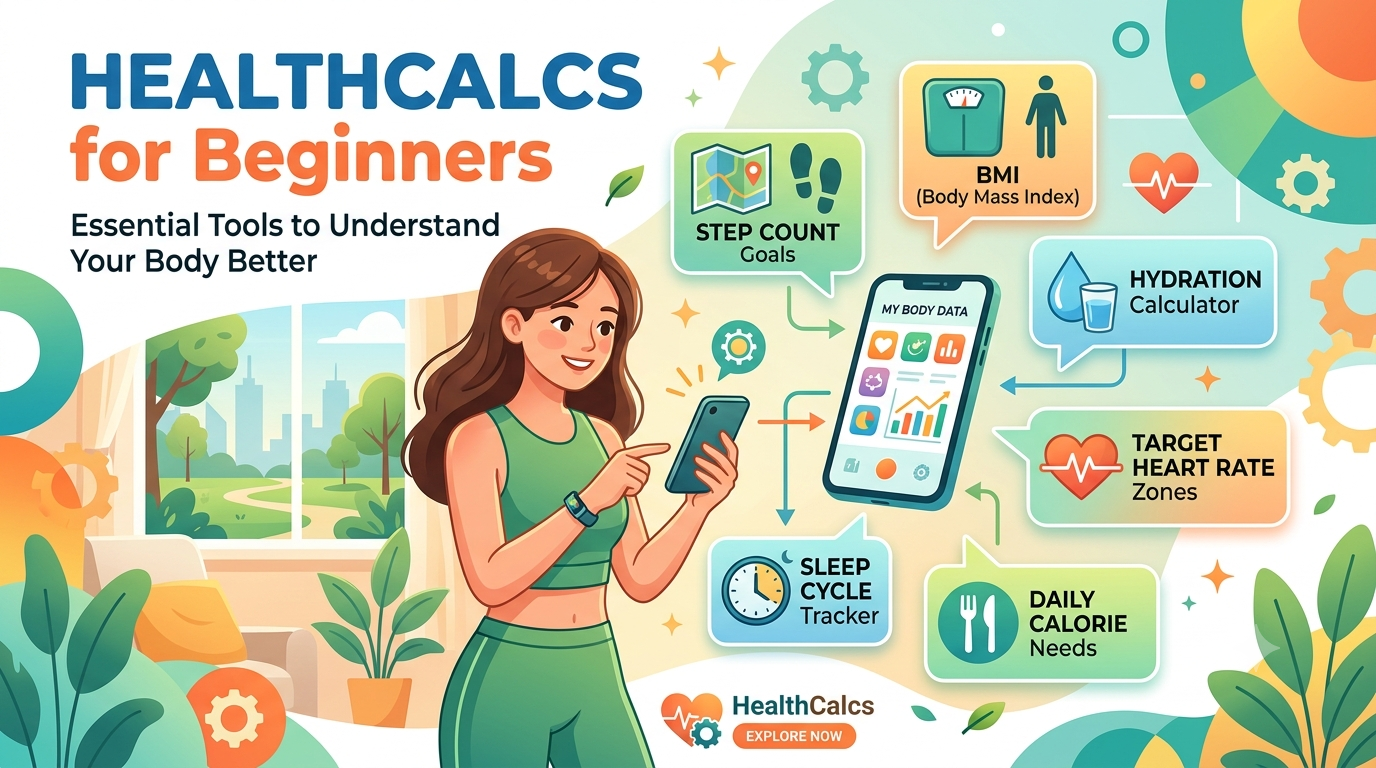
A few years ago, I genuinely thought I had a “pretty healthy lifestyle.”
I wasn’t doing anything extreme. I walked a bit, tried to avoid junk food, and occasionally attempted home workouts when motivation showed up. On paper, it sounded fine.
But the problem was—I had no real idea what was actually going on inside my body.
Some weeks I felt energetic. Other weeks I felt drained for no obvious reason. My weight would randomly fluctuate, and I’d convince myself something was wrong… or that I was “off track.”
Truth is, I wasn’t off track. I just wasn’t tracking anything properly.
That’s when I started using HealthCalcs tools.
Not in a complicated or obsessive way. Just simple calculators that helped me understand basic things about my body.
And honestly, that changed how I look at health completely.
Why Beginners Struggle Without Health Tracking
When you’re just starting your fitness or health journey, everything feels confusing.
You hear things like:
- “Eat in a calorie deficit”
- “Track your macros”
- “Check your body fat”
- “Monitor your BMR”
But nobody really explains what that means in real life.
I remember opening a fitness app for the first time and feeling like I needed a degree just to understand it.
So I ignored most of it and just “tried my best.”
That’s where most beginners go wrong—including me.
HealthCalcs tools simplified that chaos for me.
Instead of guessing, I could actually see numbers that made sense.
Not perfect numbers. Just helpful ones.
The First Thing I Learned: Your Body Has Baseline Numbers
One of the biggest mindset shifts I had was realizing this:
Your body already has a “starting point.”
You don’t need to guess everything.
You can calculate things like:
- How many calories your body burns daily
- Your approximate body fat percentage
- Your ideal water intake
- Your BMI category
- Your basic metabolic rate
Once I understood that, health stopped feeling random.
1. BMI Calculator – My First Reality Check
The first HealthCalcs tool I ever used was a BMI calculator.
I didn’t think much of it at the time. I just wanted to “see where I stand.”
When I entered my height and weight, I expected a normal result.
It wasn’t exactly what I expected.
I wasn’t in the “danger zone,” but I also wasn’t as fit as I assumed.
That moment wasn’t depressing—it was grounding.
Why beginners should use it:
- Gives a quick health snapshot
- Helps identify weight categories
- Easy starting point for understanding your body
What I learned later:
BMI isn’t perfect. It doesn’t know if you have muscle or fat. But for beginners, it’s a simple starting reference.
2. Calorie Calculator – The Tool That Changed Everything
If I had to pick just one tool for beginners, this would be it.
I used to think:
“I eat normal, so my calories must be fine.”
Turns out, I had no idea what “normal” meant in numbers.
A calorie calculator showed me my maintenance calories based on:
- Age
- Height
- Weight
- Activity level
And I remember thinking, “There’s no way I eat that much.”
But when I actually tracked food using MyFitnessPal, reality hit differently.
Things I wasn’t counting properly:
- Cooking oil
- Snacks
- Sugary drinks
- Portion sizes
Nothing extreme—but enough to matter.
What changed after I used it:
- I stopped overeating without realizing
- My energy became more stable
- Weight management finally made sense
3. Body Fat Calculator – Understanding What the Scale Hides
This was a game changer for me.
There was a time when my weight didn’t change for weeks. I felt stuck and frustrated.
But when I checked my body fat percentage, something interesting happened:
My body composition was improving even though the scale wasn’t moving.
That’s when I realized:
The scale is not the full story.
Why it matters for beginners:
- Shows real fat vs muscle changes
- Prevents unnecessary frustration
- Helps track real progress
4. Lean Body Mass Calculator – The Hidden Metric
Before using HealthCalcs, I had never even heard of lean body mass.
Now it’s one of my favorite metrics.
It includes everything except fat:
- Muscle
- Bones
- Water
- Organs
When I started exercising regularly, I realized I wasn’t just losing weight—I was changing body composition.
That made motivation much easier to maintain.
5. BMR Calculator – Why You Feel Tired on “Healthy Diets”
This one explained a lot for me personally.
I used to follow very low-calorie diets thinking it would speed up fat loss.
Instead, I felt:
- Tired
- Irritable
- Unfocused
Then I learned about BMR (Basal Metabolic Rate).
It shows how many calories your body needs just to function at rest.
When I compared my intake with my BMR, I realized I had been under-eating for a long time.
That explained everything.
6. Water Intake Calculator – The Most Ignored Beginner Mistake
Most beginners (including me) underestimate hydration.
I used to think:
“If I drink water when I’m thirsty, I’m fine.”
But after using a water intake calculator, I realized I was consistently under-hydrated.
Small changes I noticed after fixing it:
- Less fatigue
- Better focus
- Improved workouts
- Fewer headaches
Nothing dramatic—but noticeable.
7. Sleep Calculator – Fixing My Random Sleep Pattern
Sleep used to be random for me.
Sometimes I slept late. Sometimes early. No real system.
A sleep calculator helped me understand sleep cycles.
Instead of focusing only on “hours,” I started focusing on timing.
That helped reduce groggy mornings more than I expected.
My Simple Beginner System Using HealthCalcs
When I started, I didn’t try everything at once. That would have been overwhelming.
Instead, I followed a simple approach:
Step 1:
Check BMI and get a basic idea of my weight category.
Step 2:
Calculate daily calorie needs.
Step 3:
Start tracking food lightly (not obsessively).
Step 4:
Add water and sleep awareness.
Step 5:
Review progress monthly, not daily.
That’s it.
Simple works better than complicated.
Common Mistakes Beginners Make
I made almost all of these at some point:
1. Over-tracking everything
It becomes stressful and unsustainable.
2. Expecting fast results
Health changes take time.
3. Using incorrect inputs
Guessing your activity level ruins accuracy.
4. Comparing with others
Everyone’s body is different.
5. Ignoring consistency
One good week means nothing without patterns.
Tools That Help Beginners Stay Consistent
These apps made HealthCalcs easier to use:
- MyFitnessPal → food tracking
- Fitbit → sleep and activity tracking
- Google Fit → simple daily health data
- Apple Health → centralized tracking
- Cronometer → detailed nutrition info
They help turn calculations into real habits.
One Helpful Resource I Personally Use
When I want quick, reliable health estimates in one place, I use:
https://www.calculator.net/health-calculator.html
It’s simple, beginner-friendly, and covers most basic health calculations.
Final Thoughts From Real Experience
If I had to explain everything I learned in one simple idea, it would be this:
You don’t need to understand everything about your body at once—you just need a starting point.
HealthCalcs gave me that starting point.
Not perfect answers. Not instant transformation. Just clarity.
And once things became clearer, it became much easier to stay consistent without feeling lost.
For beginners especially, that clarity is often the difference between giving up and actually building lasting habits.
Written & Reviewed by Dr. Zil e Norain Tanveer
MBBS | Health & Wellness Expert |
Dr. Zil e Norain Tanveer is a qualified medical professional with a focus on preventive healthcare, nutrition, and wellness education. She reviews all health content on HealthCalc to ensure accuracy and reliability for every reader.