I still remember the exact moment I realized I had no idea what I was doing with my health.
I was standing in my kitchen, half-eating a “healthy” breakfast I had carefully prepared, while scrolling through fitness advice on my phone. One article said I should eat more protein. Another said I was probably eating too many calories. A third one suggested my workout routine was “completely wrong.”
At that point, I wasn’t even confused anymore—I was just tired of guessing.
That’s when I started using HealthCalcs-style tools. Not as magic solutions, but as simple reality checks. And honestly, they made things way less stressful.
Instead of wondering if I was doing “enough,” I could actually measure where I stood.
Why I Stopped Guessing and Started Using Health Calculators
Before I got into health calculators, my approach was very emotional.
If I felt heavier, I assumed I was failing.
If I felt tired, I blamed my diet.
If I didn’t lose weight in a week, I thought something was broken.
None of that was accurate.
What I eventually learned is this: your body doesn’t respond well to guesswork, but it does respond well to consistency and clarity.
Health calculators helped me get both.
They don’t replace discipline or effort, but they remove a lot of confusion. And when things feel clear, it’s much easier to stay consistent.
What HealthCalcs Actually Helps With
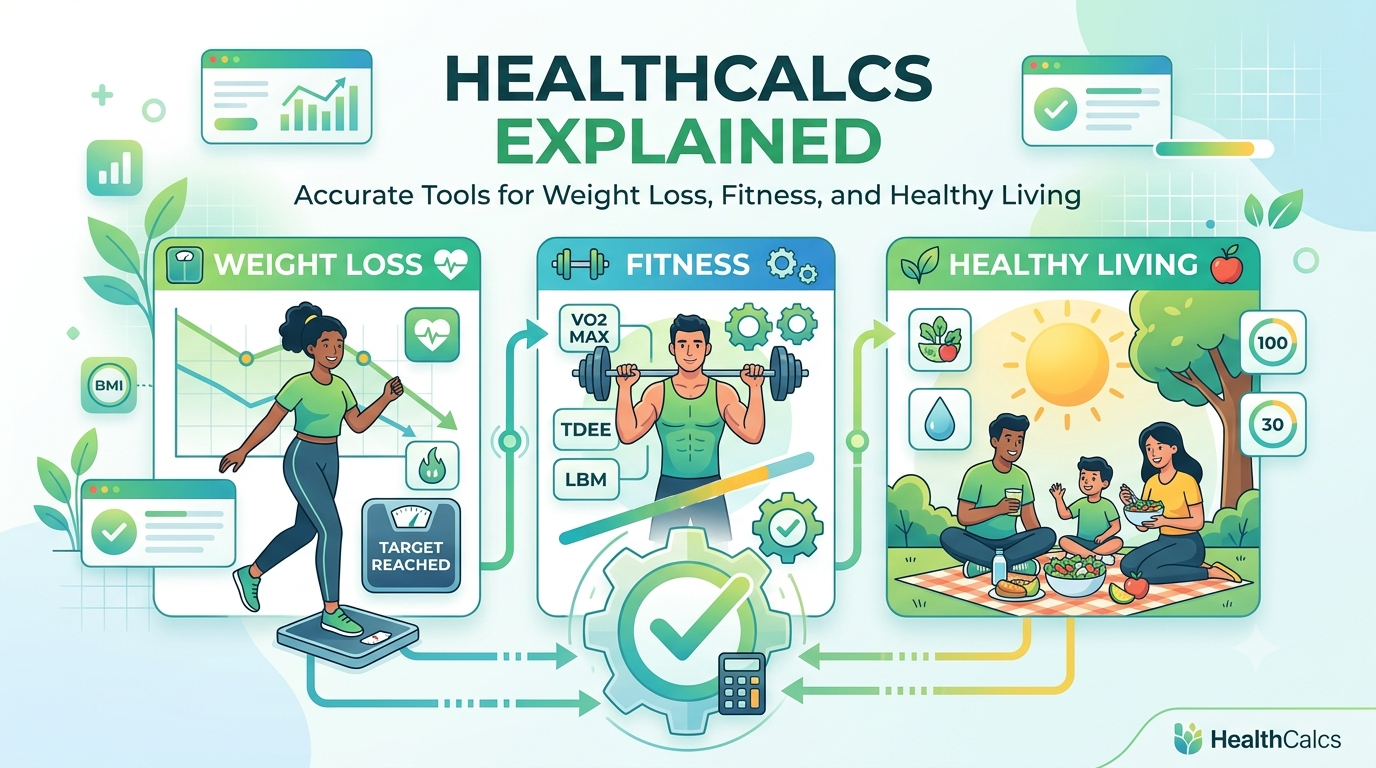
When I talk about HealthCalcs (or health calculators in general), I’m referring to tools that estimate important health numbers like:
- Calorie needs
- Body fat percentage
- BMI
- Lean body mass
- Water intake
- Sleep timing
- Metabolic rate
At first, I thought these were just “internet tools.”
But once I started using them regularly, I realized they act more like a personal health dashboard.
Not perfect. Not medical advice. But surprisingly useful for direction.
The First Eye-Opener: Calorie Calculator
The first calculator I ever used was a calorie calculator.
And honestly, it shocked me.
I had always thought I was eating “not that much.”
Turns out, I was eating way more than I realized—especially on weekends.
Things like cooking oil, snacks, and drinks were quietly adding up.
A calorie calculator helped me understand my maintenance level, which completely changed how I approached weight loss.
Instead of starving myself, I started working with a realistic calorie target.
That alone made everything more sustainable.
Simple way I use it now:
- Enter age, weight, height
- Choose activity level honestly (this part matters a lot)
- Note maintenance calories
- Create a small deficit (not extreme)
That’s it.
No complicated diet rules needed.
BMI Calculator: Useful, But Not the Whole Story
I used to take BMI very seriously.
If it went up, I panicked. If it went down, I felt relieved.
Now I see it differently.
BMI is useful for a quick general idea, but it doesn’t tell you what’s actually happening inside your body.
I’ve seen people with “normal BMI” who are not very fit, and others with higher BMI who are clearly strong and healthy.
So I treat it as a quick reference, not a final answer.
Body Fat & Lean Body Mass: The Real Game Changer
The real shift happened when I started tracking body fat percentage and lean body mass.
This is where things started making sense.
Because the scale alone can lie.
There were weeks when my weight didn’t change at all, but my body looked different in the mirror.
That’s when I understood:
- Fat loss and weight loss are not the same thing
- Muscle gain can hide fat loss on the scale
- Progress isn’t always visible in numbers
Lean body mass calculators helped me understand what I was actually made of—not just what I weighed.
That mindset change alone removed a lot of frustration.
Water Intake Calculator: The One I Ignored Too Long
I’ll be honest—I used to think hydration advice was overrated.
“Just drink water when you’re thirsty,” I thought.
But I was wrong.
When I finally used a water intake calculator based on my weight and activity level, I realized I was consistently under-hydrated.
That explained a lot:
- Afternoon tiredness
- Random headaches
- Low workout energy
Once I fixed that, I noticed small but real improvements in daily energy.
Nothing dramatic. Just better consistency.
Sleep Calculator: The Most Underrated Tool
I used to think sleep was simple: go to bed early, wake up rested.
But that didn’t always happen.
Some days I slept 8 hours and still felt awful.
That’s when I learned about sleep cycles.
Sleep calculators estimate wake-up times based on 90-minute sleep cycles, which helped me understand why some mornings felt worse than others.
When I adjusted my sleep timing instead of just sleep duration, things improved.
Not instantly—but noticeably.
My Routine Using Health Calculators (Simple Version)
I don’t use every calculator daily. That would honestly be overwhelming.
Instead, I keep it simple:
Once a month:
- BMI check
- Body fat estimate
- Weight trend review
Every 2–3 months:
- Calorie recalculation
- Activity level update
- Goal adjustment
Daily habits:
- Water tracking (roughly)
- Sleep timing awareness
- Step count (using phone or watch)
Tools like MyFitnessPal, Fitbit, and Google Fit help connect all of this without stress.
Where Most People Go Wrong (I Did Too)
After talking with friends and trying this myself, I’ve noticed a few common mistakes.
1. Using too many calculators at once
It creates confusion instead of clarity.
2. Treating numbers like absolute truth
They are estimates, not medical diagnoses.
3. Changing everything at the same time
That usually leads to burnout.
4. Expecting instant results
Health changes are slow, not sudden.
5. Ignoring consistency
One calculation doesn’t matter—patterns do.
I’ve made all of these mistakes at some point.
A Real Example That Changed My Thinking
A friend of mine was frustrated because he “wasn’t losing weight,” even though he was dieting.
When we checked his calorie intake using a calculator and a tracking app, we discovered something interesting:
He was accurate on weekdays… but completely off on weekends.
Those two days were undoing five days of progress.
Once he saw that clearly, he didn’t need motivation anymore—just awareness.
That’s the real value of HealthCalcs tools.
They don’t force change.
They reveal patterns.
Why These Tools Actually Work (When Used Right)
Health calculators are not magic.
They don’t burn fat for you.
They don’t build muscle.
They don’t fix sleep automatically.
But they do something important:
They turn vague goals into measurable actions.
Instead of saying:
“I want to get fit”
You start thinking:
“I need to stay within this calorie range, improve sleep consistency, and track my progress monthly.”
That shift makes everything easier to manage.
One Helpful Resource I Keep Coming Back To
If you want a simple place to explore multiple health calculators in one spot, this is a good starting point:
https://www.calculator.net/health-calculator.html
I’ve used it several times when I just needed quick, reliable estimates without overthinking.
Final Thoughts (From Personal Experience)
The biggest thing I learned from using HealthCalcs tools is surprisingly simple.
You don’t need perfect knowledge to improve your health.
You just need better starting points.
Once I stopped guessing and started measuring—even roughly—everything became less stressful.
Not perfect. Not instant. But clearer.
And clarity, in health and fitness, is often what keeps people going long enough to actually see results.
Written & Reviewed by Dr. Zil e Norain Tanveer
MBBS | Health & Wellness Expert |
Dr. Zil e Norain Tanveer is a qualified medical professional with a focus on preventive healthcare, nutrition, and wellness education. She reviews all health content on HealthCalc to ensure accuracy and reliability for every reader.