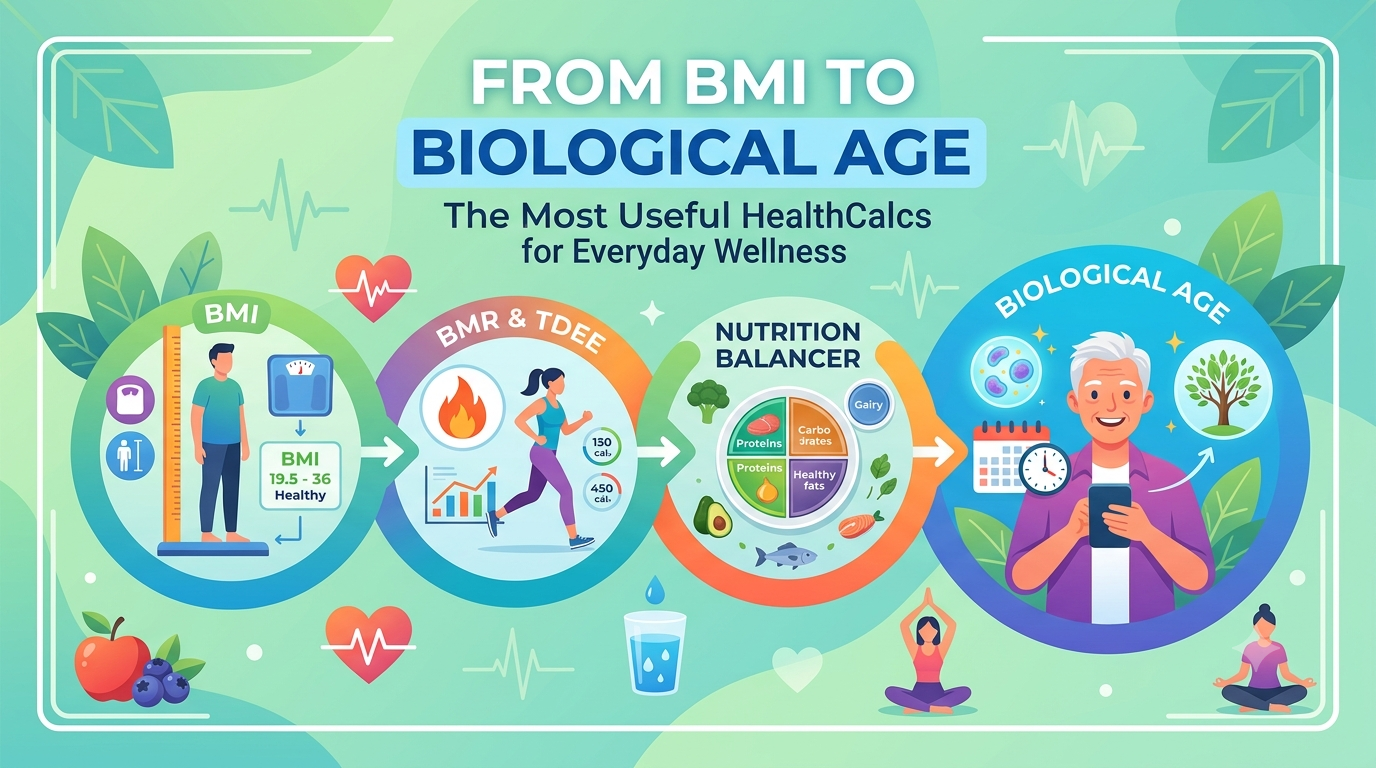
I still remember the moment I first took my health seriously—not because of motivation, but because I felt confused.
I was doing “all the right things.” Eating better, walking more, even trying home workouts whenever I had energy. But my body felt inconsistent. Some days I felt light and active, other days sluggish for no clear reason.
And the worst part? I had no real way to explain what was happening.
That’s when I stumbled into HealthCalcs tools—not as a fitness trend, but as a way to understand my body in numbers instead of guesses.
And slowly, things started making sense.
Not perfectly. But enough to finally feel in control.
Why Simple Numbers Changed Everything for Me
At first, I honestly didn’t think calculators would help much.
I assumed health was about discipline, not numbers.
But the truth hit me later:
You can’t manage what you don’t understand.
And most of us are trying to manage health without any baseline understanding.
We guess calories.
We guess fitness levels.
We guess if we’re improving.
HealthCalcs tools remove a lot of that guessing.
Starting Point: BMI (The First Reality Check)
Like most people, BMI was the first health calculator I ever used.
It felt too simple at first—just height and weight. I didn’t expect anything meaningful from it.
But when I checked my result, it made me pause.
Not because it was extreme, but because it didn’t match what I felt about my body.
That was my first lesson:
Feelings are not measurements.
What BMI helped me understand:
- Basic weight category
- General health direction
- Whether I was under, normal, or over a healthy range
What I learned later:
BMI is just a starting point. It doesn’t show muscle, fat, or fitness level. But for everyday awareness, it still matters.
BMR: The Number That Explains “Why I’m Always Tired”
Before I learned about BMR (Basal Metabolic Rate), I thought my tiredness was random.
Some days I felt okay, other days I felt drained for no clear reason.
Then I calculated my BMR.
It explained a lot.
I had been eating below what my body actually needed just to function.
That meant even without exercise, my body wasn’t getting enough fuel.
No wonder I felt low energy.
Why BMR matters in daily wellness:
- Helps prevent under-eating
- Sets realistic calorie expectations
- Explains energy levels better
This was one of the first times I felt like my body finally made sense.
TDEE: The Missing Link Between Diet and Real Life
If BMR is your baseline, TDEE (Total Daily Energy Expenditure) is your real life number.
It includes:
- Walking
- Work activity
- Exercise
- Daily movement
When I first calculated mine, I realized something important:
My idea of “being active” was slightly exaggerated.
I wasn’t as active as I thought—but I also wasn’t as inactive as I feared.
That clarity helped me stop swinging between extremes.
Why TDEE is so useful:
- Helps plan fat loss properly
- Makes maintenance easier
- Prevents crash dieting
This became the foundation of how I now plan my nutrition.
Body Fat Percentage: When the Scale Starts Lying
There was a phase where I checked my weight almost daily.
It became frustrating because the number kept going up and down for no clear reason.
But when I checked my body fat estimate, things looked different.
My body was changing—but the scale wasn’t showing it clearly.
That was a big mindset shift.
Weight is just one layer. Body composition tells a deeper story.
What body fat tracking helps with:
- Fat loss clarity
- Muscle gain awareness
- Better progress tracking than weight alone
Once I understood this, I stopped obsessing over daily weight changes.
Lean Body Mass: The Metric Nobody Talks About Enough
Lean body mass was something I ignored for a long time.
Now I see it as one of the most important indicators.
It includes:
- Muscle
- Bone
- Water
- Organs
Basically everything except fat.
When I started strength training, this helped me understand that I wasn’t just “losing weight”—I was reshaping my body.
That changed my motivation completely.
Instead of chasing the scale, I started focusing on strength and consistency.
Biological Age: The Most Eye-Opening Health Metric
This is the one that surprised me the most.
Biological age doesn’t just look at your calendar age—it estimates how your body is aging based on lifestyle factors.
The first time I used it, I didn’t really know what to expect.
But the result made me think.
Not in a stressful way—but in a reflective one.
It showed me how things like:
- Sleep
- Stress
- Activity
- Diet consistency
all connect to long-term health.
Why biological age matters:
- Gives long-term health perspective
- Highlights lifestyle impact
- Encourages better habits over time
It’s less about numbers and more about awareness.
How I Use HealthCalcs in Real Life (Simple System)
I don’t use everything every day. That would be overwhelming.
Instead, I follow a simple rhythm:
Weekly:
- Weight check
- Basic calorie awareness
- Activity tracking (steps via phone or Fitbit)
Monthly:
- BMI check
- Body fat estimate
- Waist measurement
Every few months:
- Recalculate TDEE
- Review progress honestly
- Adjust goals if needed
This keeps things balanced without becoming obsessive.
Real Example That Made It All Click
A friend once told me:
“I’m eating healthy but nothing is changing.”
We didn’t change his diet immediately. We started with numbers.
We calculated his TDEE and tracked his intake for a few days.
The issue wasn’t effort—it was inconsistency.
Weekdays were fine. Weekends weren’t.
Once he saw that clearly, things became easier to fix.
That’s the real value of HealthCalcs—it shows patterns you don’t notice otherwise.
Common Mistakes People Make With Health Calculations
I’ve made most of these myself:
1. Using too many tools at once
More data doesn’t always mean better clarity.
2. Obsessing over daily changes
Your body doesn’t update in 24-hour cycles.
3. Guessing inputs
Wrong activity level = wrong results.
4. Expecting instant transformation
These tools guide decisions, not miracles.
5. Ignoring consistency
One good day doesn’t define health.
Once I stopped doing these things, everything felt more stable.
Tools That Help Me Stay Consistent
These apps made HealthCalcs practical in daily life:
- MyFitnessPal → calorie tracking
- Fitbit → sleep + activity
- Apple Health → centralized health data
- Google Fit → simple monitoring
- Cronometer → nutrition breakdown
They turn numbers into habits instead of just information.
One Helpful Resource I Still Use
When I want quick and reliable health estimates, I use:
https://www.calculator.net/health-calculator.html
It’s simple, fast, and covers most basic health metrics in one place.
Final Thoughts From Real Experience
The biggest thing I’ve learned from using HealthCalcs tools is simple:
Health becomes less confusing when you stop guessing and start understanding.
Before I used them, I was putting in effort without clear direction.
After using them, I wasn’t perfect—but I was aware.
And that awareness changed everything:
- My decisions became clearer
- My habits became more structured
- My expectations became more realistic
Not because the tools did the work for me—but because they helped me see what was actually happening.
And once you see clearly, improving becomes a lot more natural.
Written & Reviewed by Dr. Zil e Norain Tanveer
MBBS | Health & Wellness Expert |
Dr. Zil e Norain Tanveer is a qualified medical professional with a focus on preventive healthcare, nutrition, and wellness education. She reviews all health content on HealthCalc to ensure accuracy and reliability for every reader.