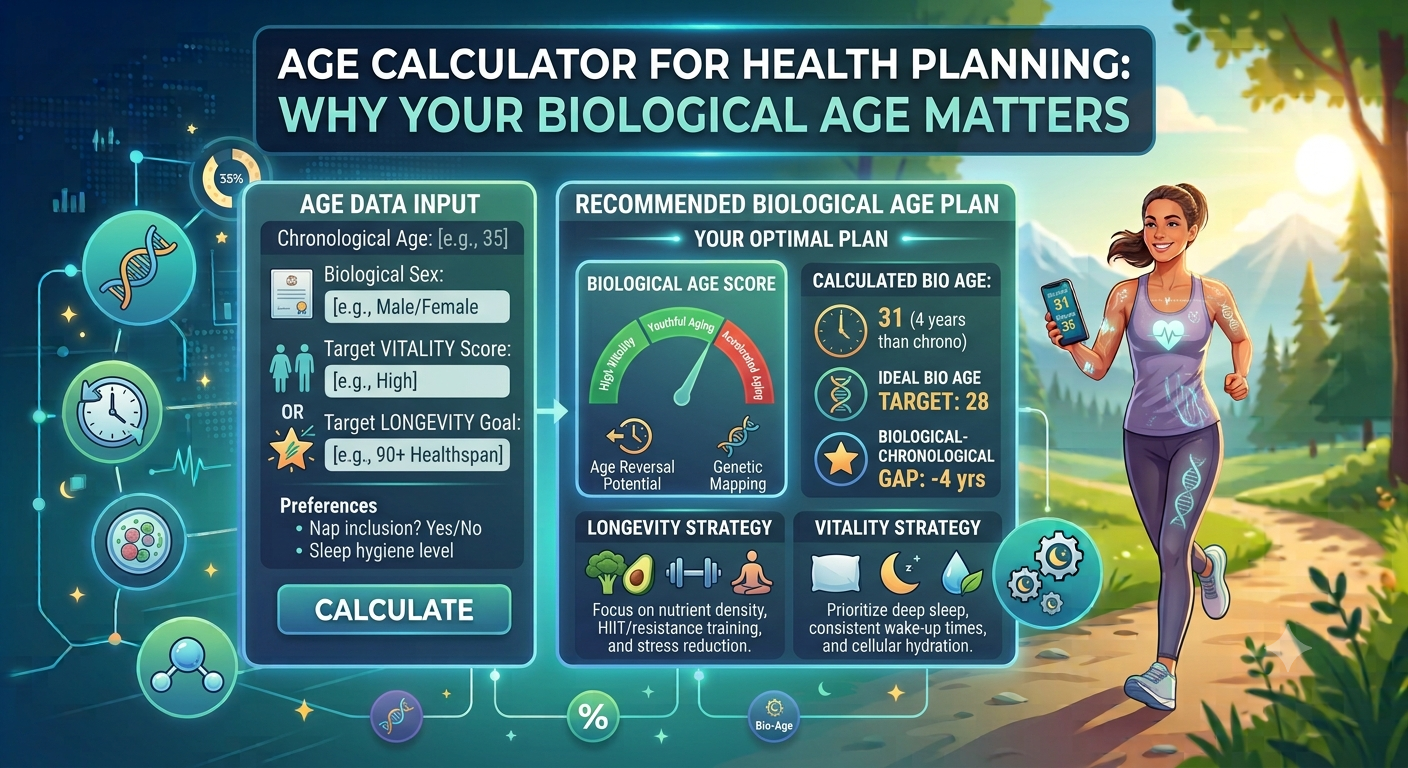
A few years ago, I had one of those moments that makes you stop and rethink your habits.
I was filling out a health assessment form before a routine checkup. The form asked for my age, weight, activity level, sleep habits, and a few other details. After entering everything into an online health-age calculator, I expected nothing interesting.
I was 38 years old at the time.
The calculator estimated that my body was functioning more like someone in their mid-40s.
At first, I laughed it off.
Then I looked at my daily routine.
Too much sitting. Poor sleep. Constant stress. Weekend workouts that were supposed to compensate for an entire week of inactivity.
That experience introduced me to something many people are hearing about today: biological age.
Most of us know our chronological age—the number of years we've been alive. But biological age is different. It attempts to measure how well your body is actually aging based on factors like fitness, sleep, blood markers, lifestyle habits, and overall health.
And when it comes to health planning, biological age can sometimes tell a more useful story than the date on your birth certificate.
What Is Biological Age?
Think about two people who are both 50 years old.
One walks several miles a day, sleeps well, eats reasonably healthy meals, and has normal blood pressure.
The other barely exercises, struggles with sleep, and has several health risk factors.
Technically, both are the same age.
But their bodies may not be aging at the same rate.
That's where biological age comes in.
Researchers use different methods to estimate biological age, including blood biomarkers, cardiovascular health measurements, fitness levels, and even DNA methylation testing. The goal is to understand how quickly the body's systems are aging compared to the average person of the same chronological age.
Why Health Planning Should Go Beyond Your Birth Date
One mistake I used to make was assuming health planning only mattered after a certain age.
I thought:
"I'm still in my thirties. I'll worry about that stuff later."
The problem is that health doesn't suddenly change when you hit a milestone birthday.
The habits you build today influence how you'll feel years from now.
Biological age calculators can help reveal trends that aren't always obvious.
For example:
- Poor sleep may be affecting recovery.
- High stress could be impacting overall health.
- Lack of physical activity may be accelerating aging.
- Extra body weight might be increasing future health risks.
Seeing these patterns early gives you time to make adjustments before bigger problems develop.
My Biggest Lesson: Numbers Can Be Motivating
One unexpected thing I learned is that people often respond better to "health age" than traditional health statistics.
When a doctor says:
"Your cholesterol is slightly elevated."
Many people ignore it.
But if a health assessment suggests:
"Your body is aging faster than expected."
That feels more personal.
It creates a clearer connection between today's habits and tomorrow's health.
Of course, biological age estimates aren't perfect and shouldn't be treated as a diagnosis. Experts note that different calculators and testing methods can produce different results. They are best viewed as educational tools and trend indicators rather than absolute truths.
How Age Calculators Are Used in Health Planning
Today, many people use age calculators for several practical reasons.
1. Tracking Lifestyle Changes
Let's say you improve your sleep, exercise regularly, and lose some excess weight.
Over time, many health metrics improve.
Instead of focusing only on the bathroom scale, some people use biological age assessments to monitor overall progress.
2. Setting Realistic Health Goals
Rather than saying:
"I want to get healthier."
You can create measurable goals:
- Walk 8,000–10,000 steps daily
- Improve sleep quality
- Lower resting heart rate
- Improve blood pressure readings
- Increase strength and fitness
These factors often contribute to a healthier biological profile.
3. Planning for Long-Term Wellness
Many people think about retirement planning financially.
Far fewer think about physical retirement planning.
Questions worth asking include:
- Will I still be mobile at 70?
- Can I maintain independence?
- How healthy will my heart be?
- How much energy will I have?
Health planning isn't just about living longer.
It's about living better.
Popular Biological Age Tools
Over the past few years, I experimented with several calculators just out of curiosity.
Some are simple questionnaires.
Others use detailed health data.
Examples include:
- The 100 Year Life biological age assessment
- PhenoAge calculators based on blood test results
- Cardiovascular age calculators
- Fitness and wearable-based assessments
One useful starting point is the free assessment available at The 100 Year Life Calculator, which estimates biological age and healthspan using lifestyle and health information.
If you already have recent blood test results, calculators based on the PhenoAge model can provide additional insights using common biomarkers such as glucose, inflammation markers, and blood cell measurements.
Step-by-Step: How I Use Biological Age for Health Planning
Here's the simple approach that worked for me.
Step 1: Establish a Baseline
Start with your current health information.
Record:
- Weight
- Waist measurement
- Blood pressure
- Sleep habits
- Activity level
- Resting heart rate
- Recent blood test results
This becomes your starting point.
Step 2: Calculate Your Current Health Age
Use a reputable calculator.
Don't obsess over the exact number.
Focus on what the results suggest about your habits.
Step 3: Identify the Biggest Weakness
For me, it was sleep.
I originally assumed exercise was my biggest issue.
After tracking everything honestly, I realized I was averaging barely six hours of sleep.
Fixing that produced noticeable improvements in energy levels.
Step 4: Make One Change at a Time
Many people try to change everything at once.
That rarely lasts.
Instead:
- Add a daily walk.
- Improve bedtime consistency.
- Reduce sugary drinks.
- Strength train twice a week.
Small improvements accumulate surprisingly fast.
Step 5: Reassess Every Few Months
Health planning is a long game.
Check progress every three to six months rather than every few days.
Trends matter more than daily fluctuations.
Wearables Can Help
One thing that made health tracking easier for me was using a fitness watch.
Devices from brands like:
- Apple
- Garmin
- Fitbit
can track:
- Heart rate
- Sleep duration
- Activity levels
- Recovery trends
- Cardio fitness estimates
While these devices don't directly measure biological age, they provide useful data that many health-age models consider important.
Common Mistakes People Make
Treating Biological Age Like a Medical Diagnosis
A calculator result isn't the same as a doctor's evaluation.
Use it as information, not a verdict.
Chasing the Lowest Number
I've seen people become obsessed with reducing their biological age score.
The goal isn't to win a competition.
The goal is better health.
Ignoring Basic Habits
Many people search for advanced longevity hacks while neglecting fundamentals.
The basics still matter most:
- Sleep
- Exercise
- Nutrition
- Stress management
- Avoiding tobacco
- Regular health checkups
Research consistently links these habits to healthier aging outcomes.
Comparing Yourself to Others
Everyone starts from a different place.
Genetics, medical history, lifestyle, and environment all influence aging.
Compare your current self with your past self.
That's usually the most useful benchmark.
A Real-World Example
A friend of mine became interested in biological age after receiving a higher-than-expected health score during a workplace wellness program.
He didn't buy any expensive supplements.
He didn't follow extreme diets.
Instead, he focused on three changes:
- Walking daily
- Losing excess weight gradually
- Sleeping seven to eight hours most nights
Six months later, several health markers improved.
More importantly, he felt better.
His energy increased, his blood pressure improved, and everyday activities felt easier.
That's the real value of biological age tools.
Not the number itself.
The behavior changes they inspire.
What Matters Most
After experimenting with various health-age calculators over the years, I've come to a simple conclusion.
Biological age is useful when it encourages action.
It's less useful when people obsess over the score.
You don't need the perfect calculator.
You don't need expensive testing.
What you need is awareness.
If a biological age assessment motivates you to sleep better, move more, improve your nutrition, or schedule a long-overdue health checkup, then it has already done its job.
The most important health plan isn't the one that looks impressive on paper.
It's the one you can actually stick with for years.
And sometimes, seeing how your body is aging today can provide the motivation to build a healthier future tomorrow.